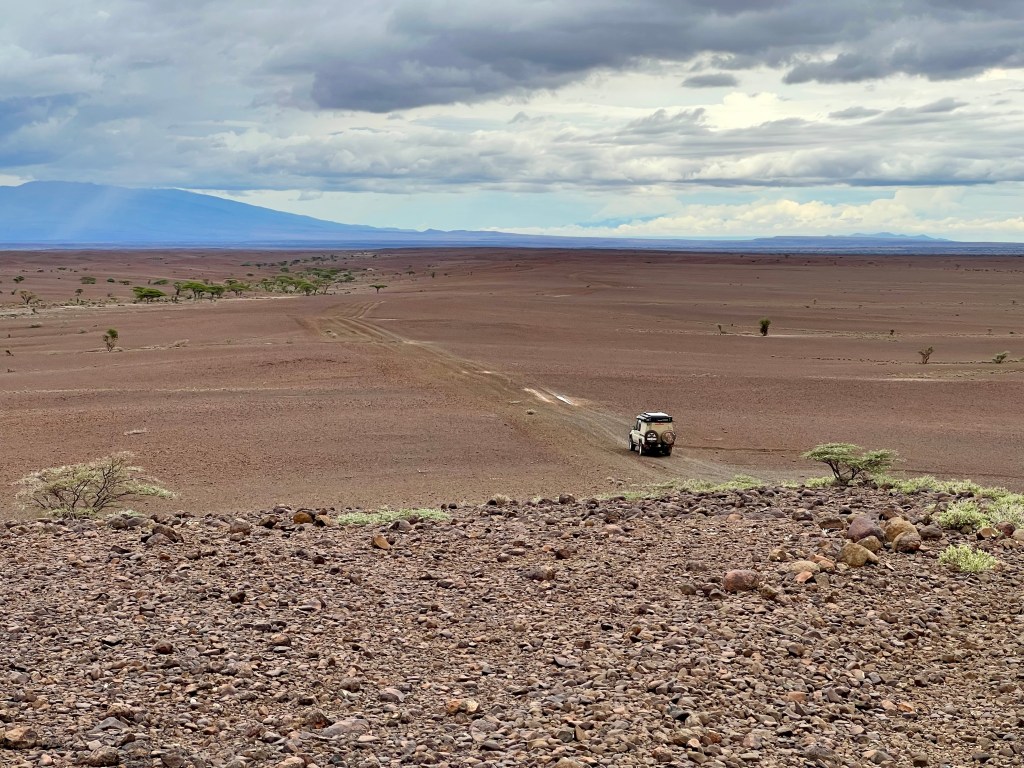
23 to 26 March 2023
Sibiloi is a national park on the eastern shores of Lake Turkana and lies north of Loiyangalani, just shy of the border with Ethiopia. It was founded as a wildlife conservation area yes, but also (and this is what it is best known for) to protect a number of important palaeontological sites. The most famous of these is Koobi Fora, a ridge rich in fossils discovered and investigated by Richard Leakey in the late ‘60’s. In 1984 paleoanthropologists discovered “Turkana Boy,” a nearly complete 1.5 million-year-old skeleton of a hominin with proportions similar to our own. Turkana Boy is the most complete early human skeleton ever found.
We wanted to go and have a look around.
It Loiyangalani we topped up with fuel again from the only petrol station. “station” is perhaps an ambitious word – more like a container:
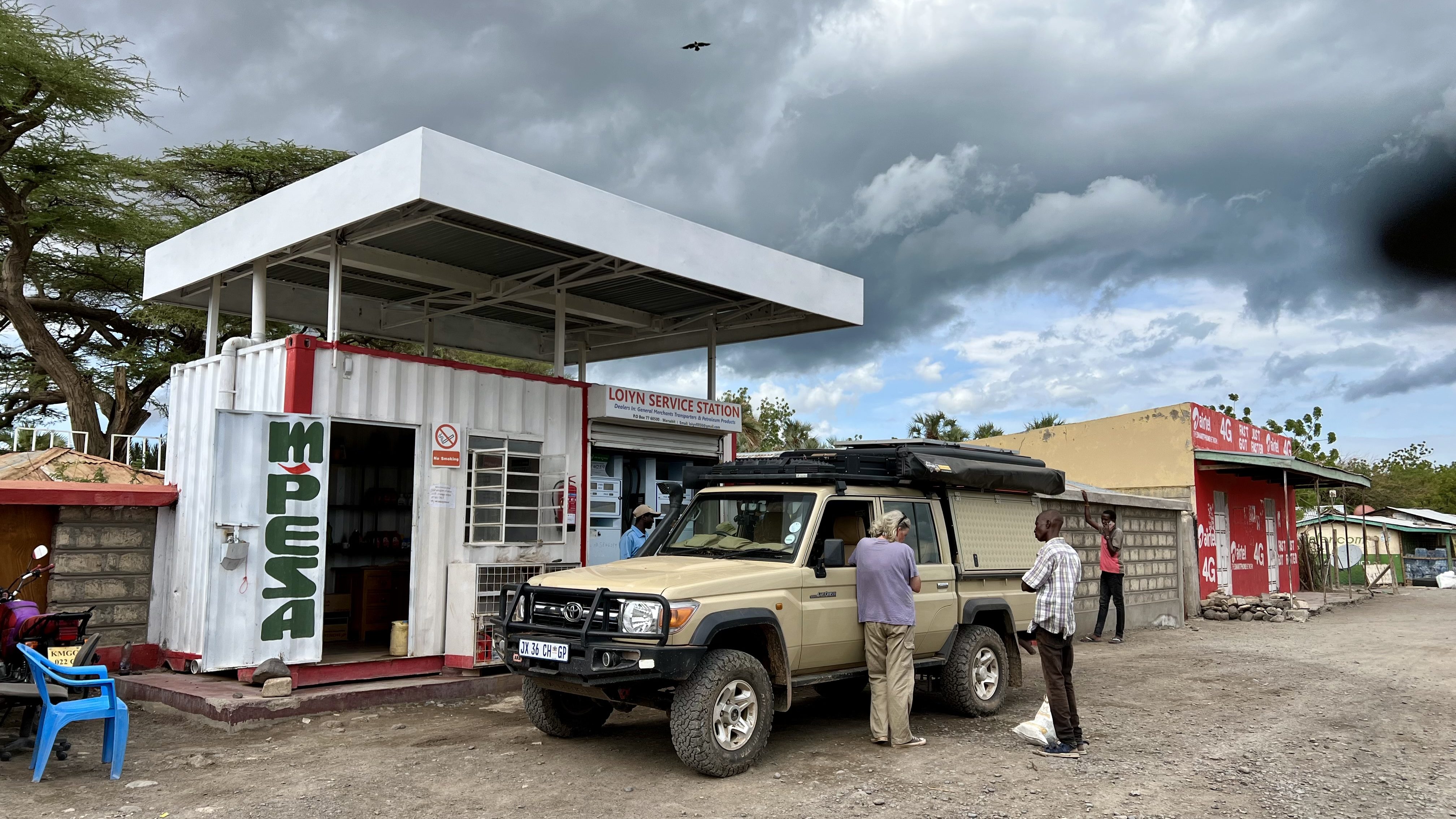
From Loiyangalani we headed north, dark clouds on the horizon. Ominous yes, instilling a (little) sense of foreboding. But, bloody minded as ever we, decide to press on, remembering to ‘bear right at the big hill’ as instructed by the hotel manager at Palm Shade.
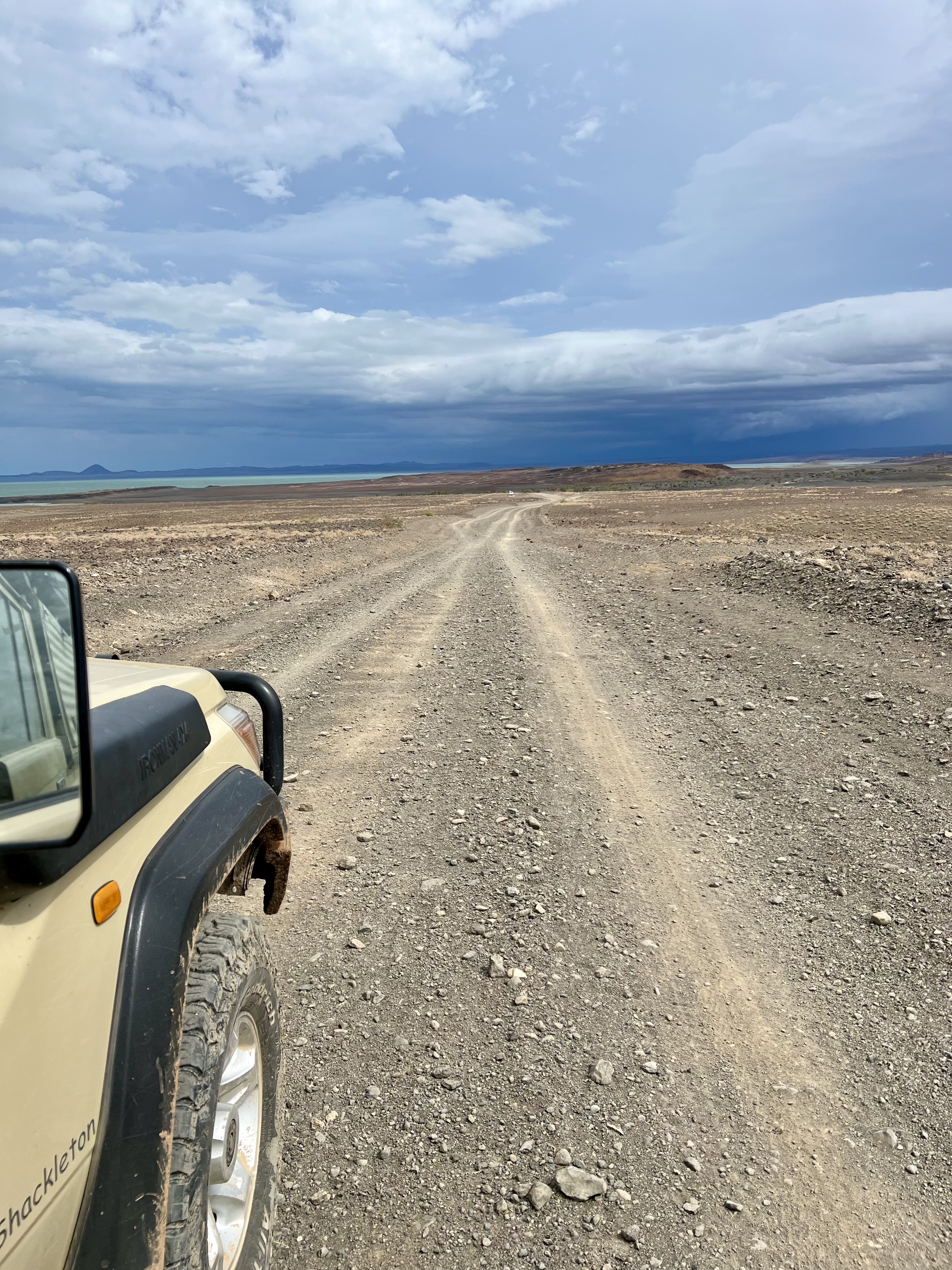
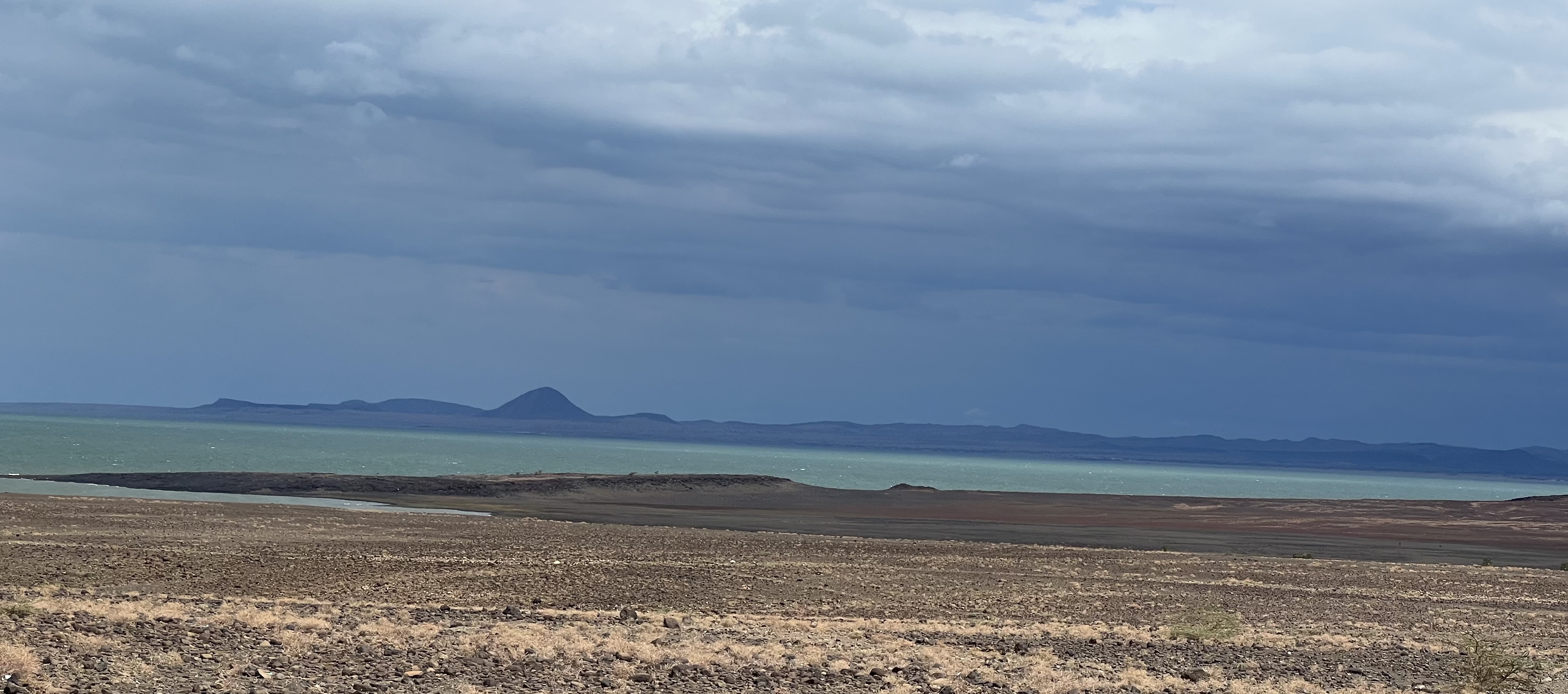
The rain holds off and it starts to lighten up, it looks like the storm is moving over the water…but it doesn’t hold for long and the next thing it is bucketing down, the track turning into rivulets and then into rivers. Some parts of the track have been concreted for which we are grateful, but that soon runs out. The surface is mainly sandy or shale so the traction isn’t bad, but in some places its muddy and very slippery.
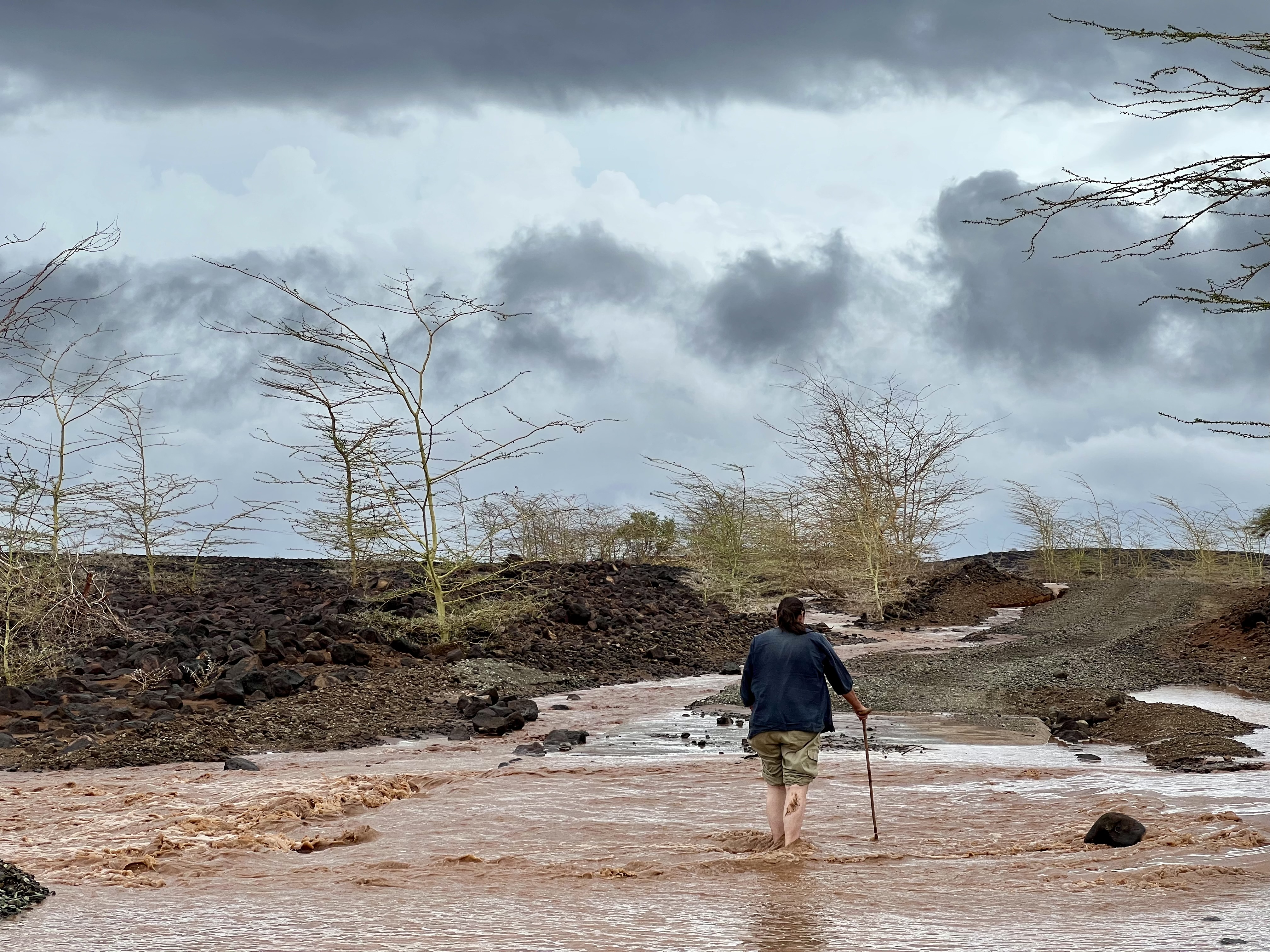
We press on, through the rain, wipers going full ball. It lets up a bit but the sheer amount of surface water is astonishing. At one point I stop at what was a dry stream bed – there is no way of knowing how deep it is and I want to walk it first. I use Dad’s Turkana stick to prod ahead. It’s fine – it’s not that deep and the surface is rocky so I turn back to get into Shackleton to see another vehicle pull up.
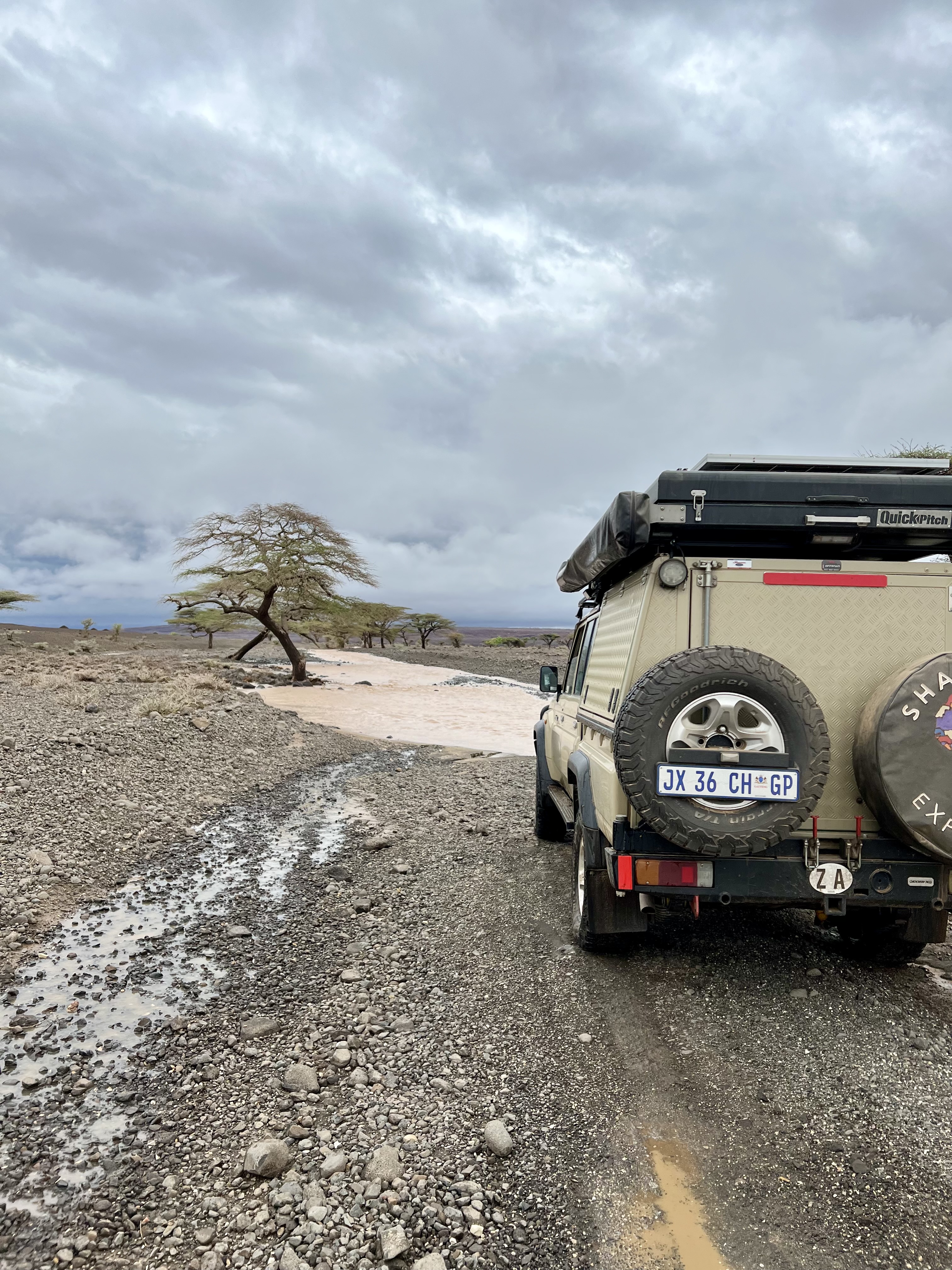
The driver gets out:
Are you OK?
Yes, yes I say. Just wanted to see how deep it was…
One of the passengers gets out and comes to join us. Introductions are made. They are rangers from KWS (Kenya Wildlife Services), on their way to Sibiloi. Where are our husbands they ask. Fishing we reply, in unison. (The fishing husbands story goes years back from an earlier Africa overlanding trip – Deb replied with this answer to the same question from a border official – we get asked this A LOT – she still doesn’t know where the answer came from – but weirdly it always works and is universally accepted without question). Joshua, the driver nods, of course you don’t like fishing, makes sense. He, Joshua tells me, “I mustn’t worry and road will be fine”. Would we like them to go ahead of us so we can see it’s safe? Hhmm. I look at his car. It’s 4X4 but a soft-roader SUV and much lower slung than us. I am quite capable of driving this. He has a confident, assured demeanour and doesn’t mean to be condescending or sexist, but that’s how it goes.
I let it go.
And anyway it’s probably not a bad thing, they know the way and I don’t want to feel rushed along with a vehicle pushing behind us. And I don’t want to antagonise, who knows, we may end up needing their help. So we pull over to let them go ahead, urging them not so wait for us as we are bound to be slower what with the heavy Cruiser and taking photos etc. Off they set, going like a bat out of hell.
In places its hard to see the where the road goes and the fresh tracks in front of us are useful.
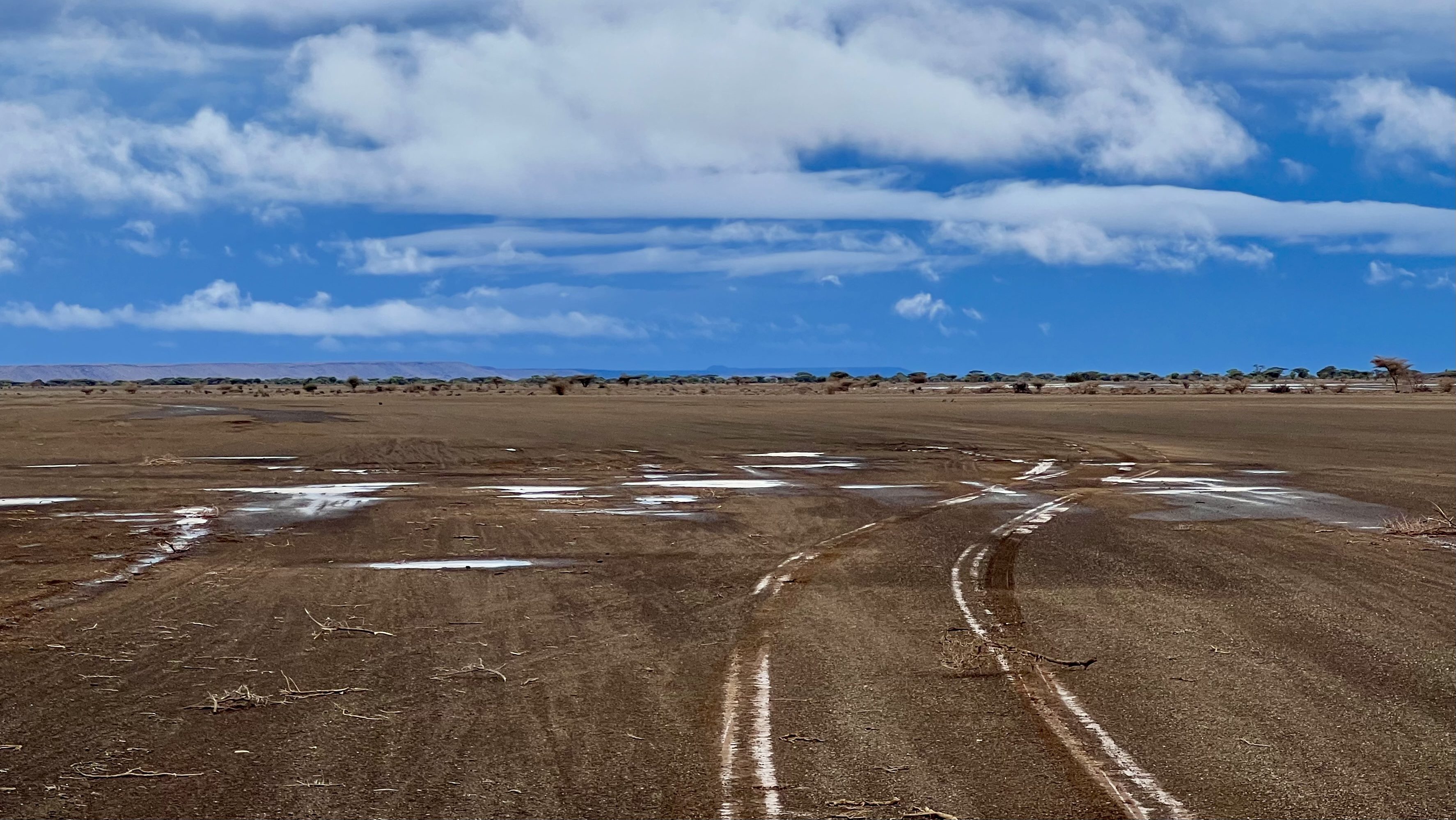
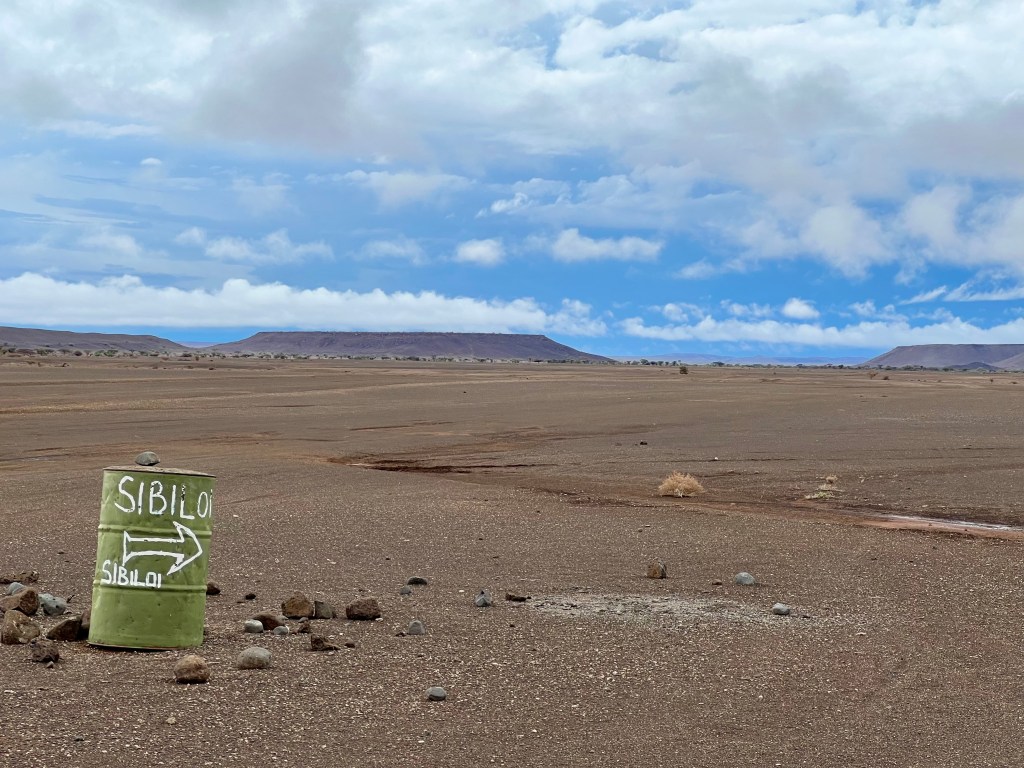
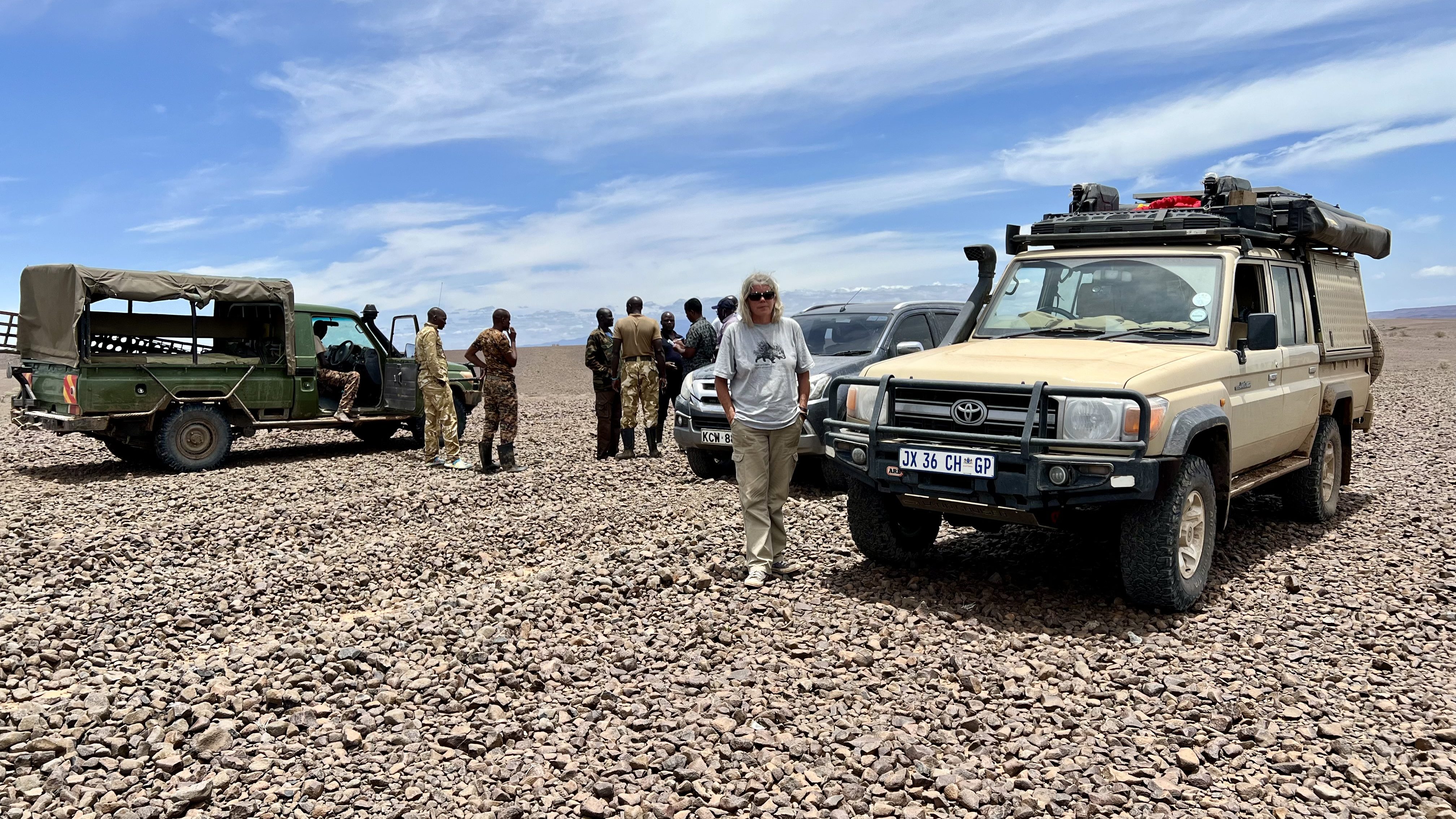
So on we go, very overcast but at least it’s not raining, and the wide open landscape is stunning. We cross a few more flowing streams but nothing too hectic until we get to one larger river. My heart sinks. I don’t get a thrill out of this kind of stuff. The SUV with the rangers has crossed and they are waiting on the other side along with a bakkie and a big truck. There are 10 or so people milling about – they urge us to cross, saying is not deep at all and pointing out the line. I get out and have a look, it’s not flowing too fast and the line is clear so we cross. Easily, it turns out. Once on the other side we park and get out to join our fellow travellers at this impromptu pit stop. It’s then that I see why we are all here – there is another river ahead, much wider and flowing way faster. Consensus is that it’s too dangerous to cross so we are waiting for it to subside. Let’s give it an hour one of the rangers says.
So there we all stand, our merry band, chatting away. Turns out they are from the Maritime division of KWS and are on a country wide tour on a boat audit / inspection. They have been at the marine reserve in Watamu so we chat about our trip to the coast, working their way up stopping at Mwea and now they are at Lake Turkana – the boats at Alia Bay at the Sibiloi KWS headquarters is their last stop on this tour. The intention is to make the inspection and be back on Loiyangalani by this evening. We are joined by Damian and his team (from the big truck). They are from the logistics division of the Dept of Museums and on their way to Koobi Fora with a mechanic to fix a vehicle, or bring it back in the truck if they can’t.
Next thing a herdsman and goats appears on the opposite bank – much yelling and joshing, sell us a goat for our supper! (Damian and Joshua translating for us). The herdsman seems agitated, gesticulating – you need to cross, he says – no, no is the reply – its too dangerous, we’ll wait for it to go down a bit – but it’s not going down the herdsman replies, the water is rising, and fast.
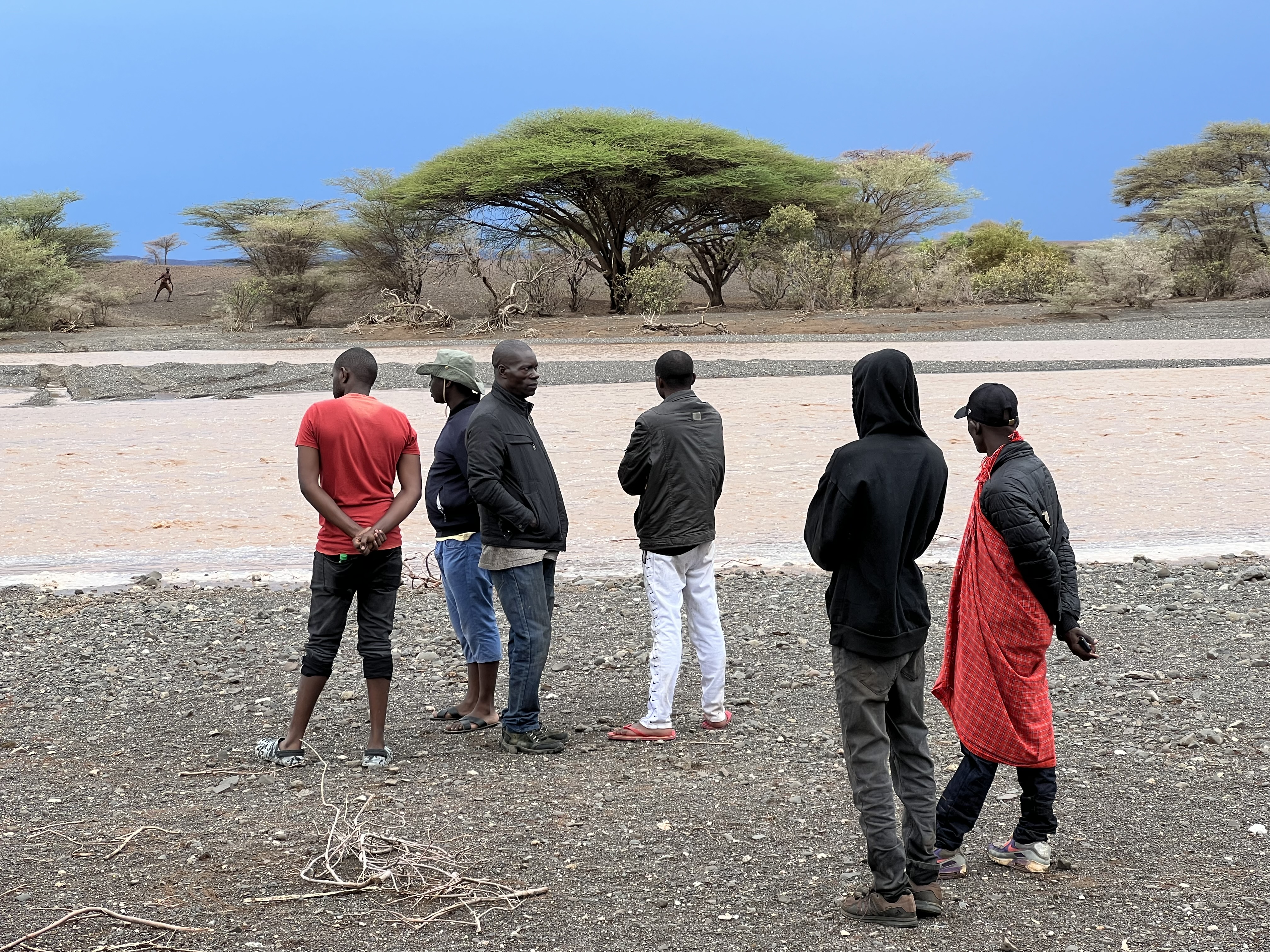
That sobers everyone up and we take a good look at the river in front of us. He’s right. It is rising. I then turn around and walk back to look at the smaller river we crossed. That is rising too. In fact the water is pumping down. We can’t cross that either now. And then it dawns on me – we are in fact on an island. A big island, but an island. In a low, wide, flat riverbed walk upstream to the furthest point of the island and stare out. The waters really are starting to rise and bits of the sandbank are starting to calve off. This is not good and I am now desperate for a pee so I find a bunch of bushes for cover. As I crouch down I catch a flash of white out of the corner of my eye and turn to look. It’s a dead goat. And then I look at the ground: water has been over here recently.
F%#$&@K
I walk back to our gang. All clucking and making reassuring noises. I’m not so sure hey. Deb has got a stick and has drawn a line in the sand so as to better judge the rising water. I look at Shackleton and wonder what our insurers will say.
And the water is still rising. Deb’s line is gone now so she has drawn another one. I start to say something but the look says it all, so I zip it. I resolve that if it comes to I’m going to grab our passports and money and get into the back of the big truck
What follows is a tense couple of hours, watching the water levels. I am kicking myself, we should never have crossed the first river on the rangers say-so. We should have looked properly ahead. And whist they call themselves rangers they are actually auditors and I’m stuck on an island with a cohort of KWS PowerPoint jockeys and THIS IS NOT GOOD.
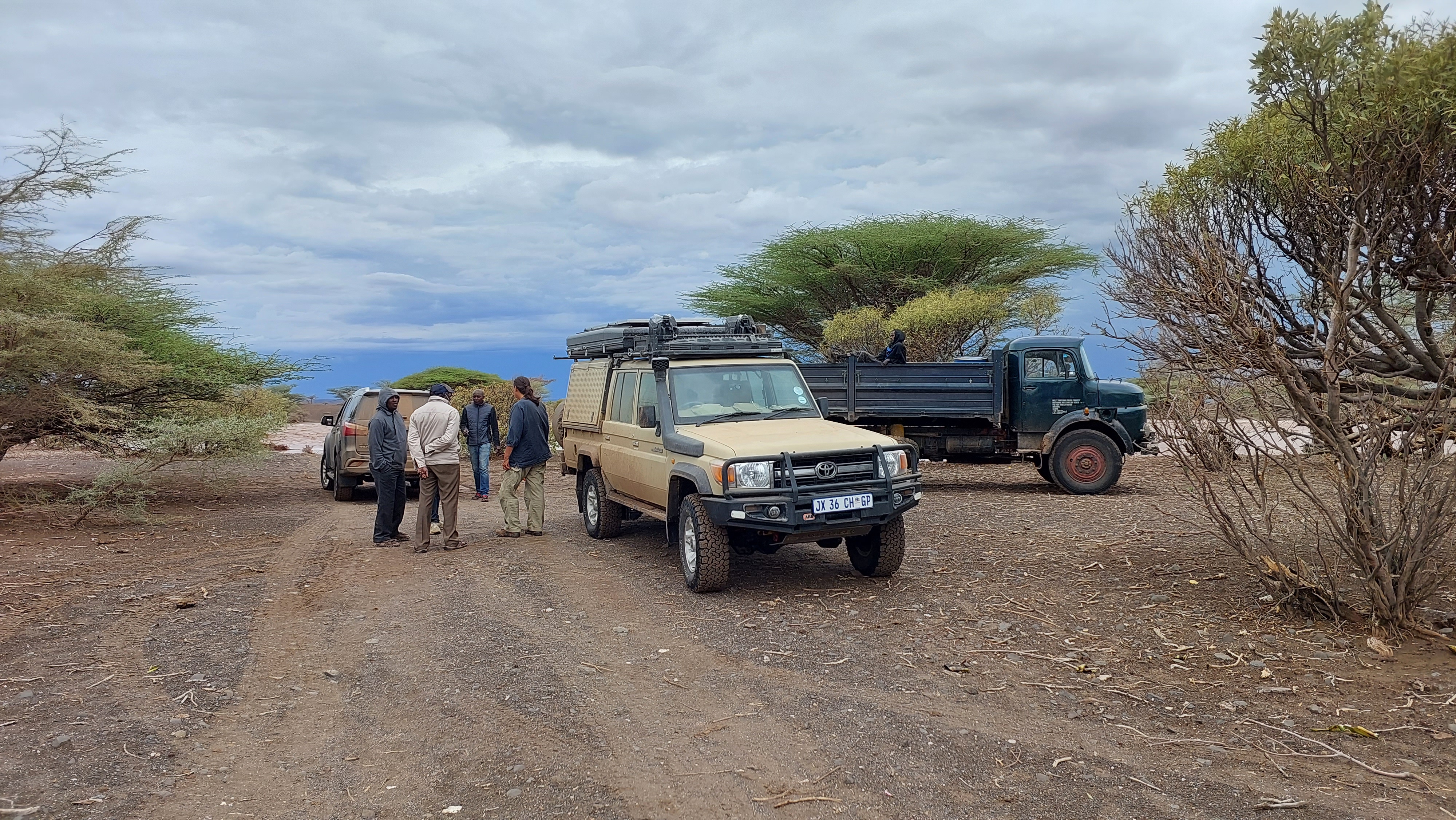
Some of the men appear pretty relaxed, joking a gathering firewood. Eventually the water starts to drop and I breathe a big sigh of relief. It is late in the day though. Damian comes over (he’s kind of taken the lead). This is going to take a while he says. Assume for now that we are spending the night here. We will get across, don’t worry. Its better if we all move together.
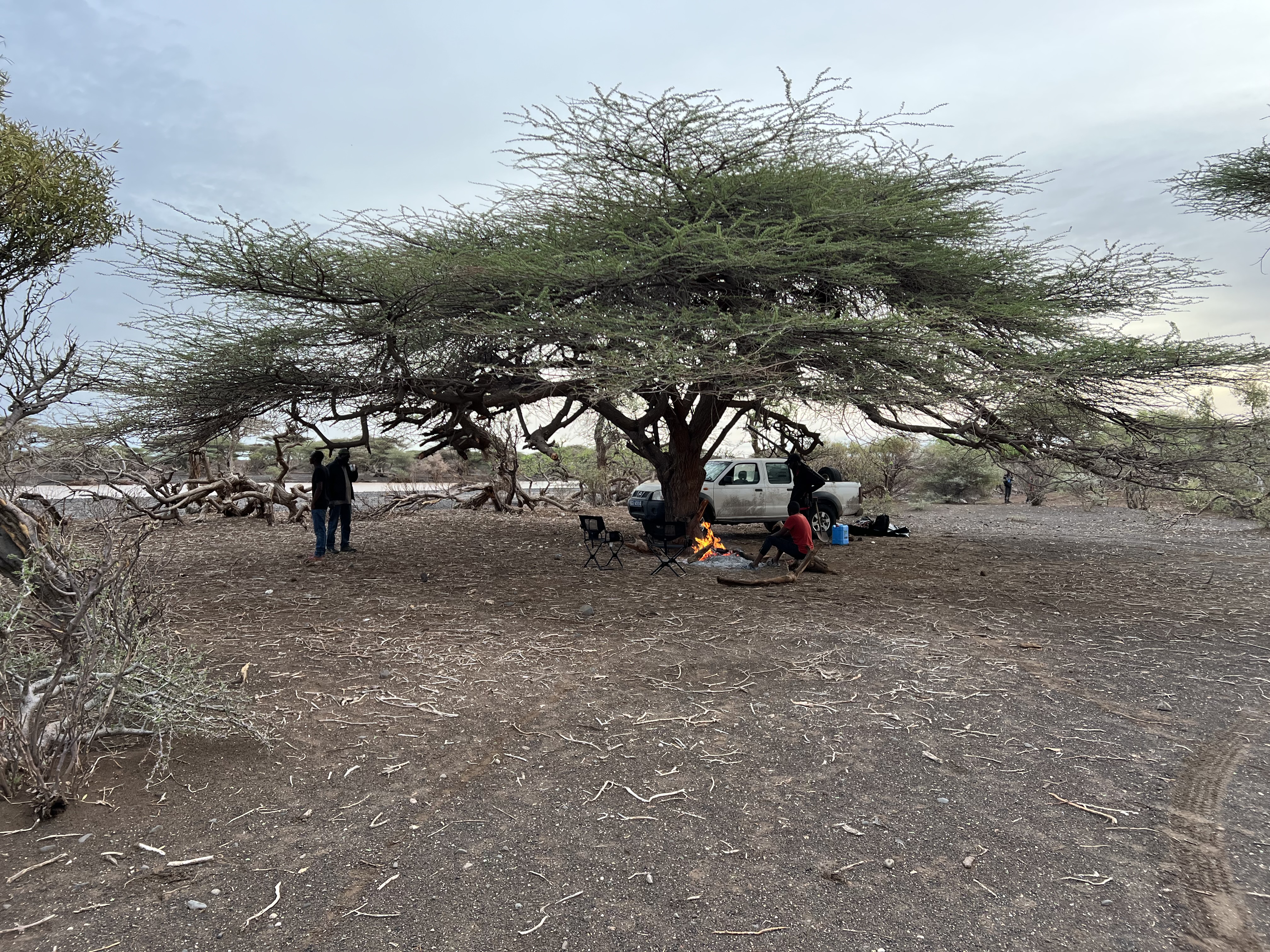
Nothing for it but to take out our chairs and put the tent up. In addition to our camp chairs we carry two lightweight Frontrunner directors chairs for when we need to work at a table with our laptops. I get these out too and offer them to whoever wants. Damian takes one as does an older man who we’ve dubbed HQ. He’s part of the auditing team and clearly their boss – you can see it in the way they defer to him. He is now looking very relieved, but not well pleased with this unexpected boys’ own adventure. Anyway a bonfire is built, potatoes are baked and offered to us. More men keep appearing out of the back of the truck, I think they’ve been sleeping all this time! I think about preparing a meal but there are too many people to feed, but we open up the kitchen and offer tea and coffee which goes down a treat. They are really curious and interested in our truck, HQ in particular, admiring the electronics and the custom made gas bottle holders…it turns into one great big show and tell. I am sure they’ve all seen tourists in these rigs but most haven’t had a chance to take a good look at the set up.
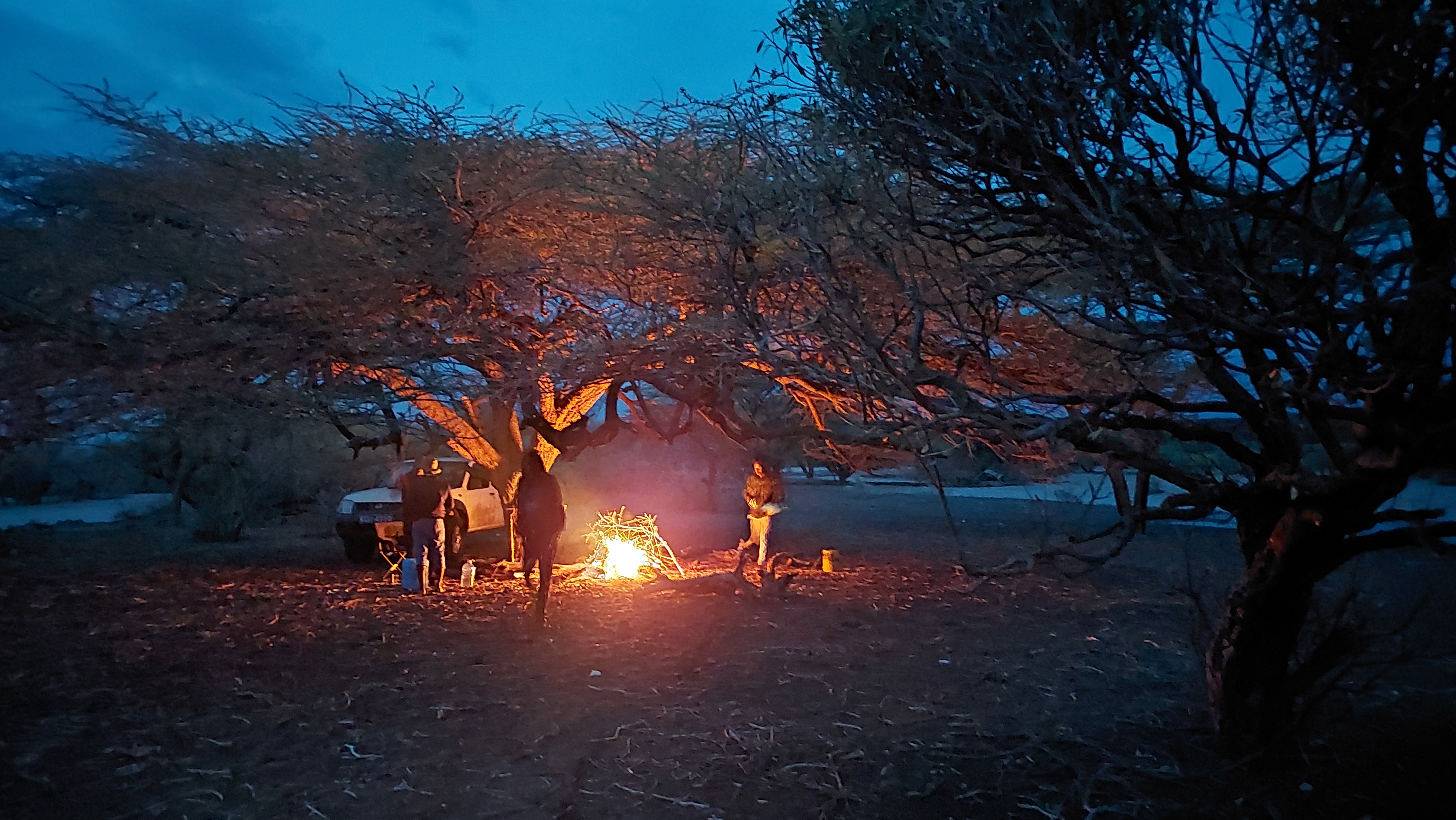
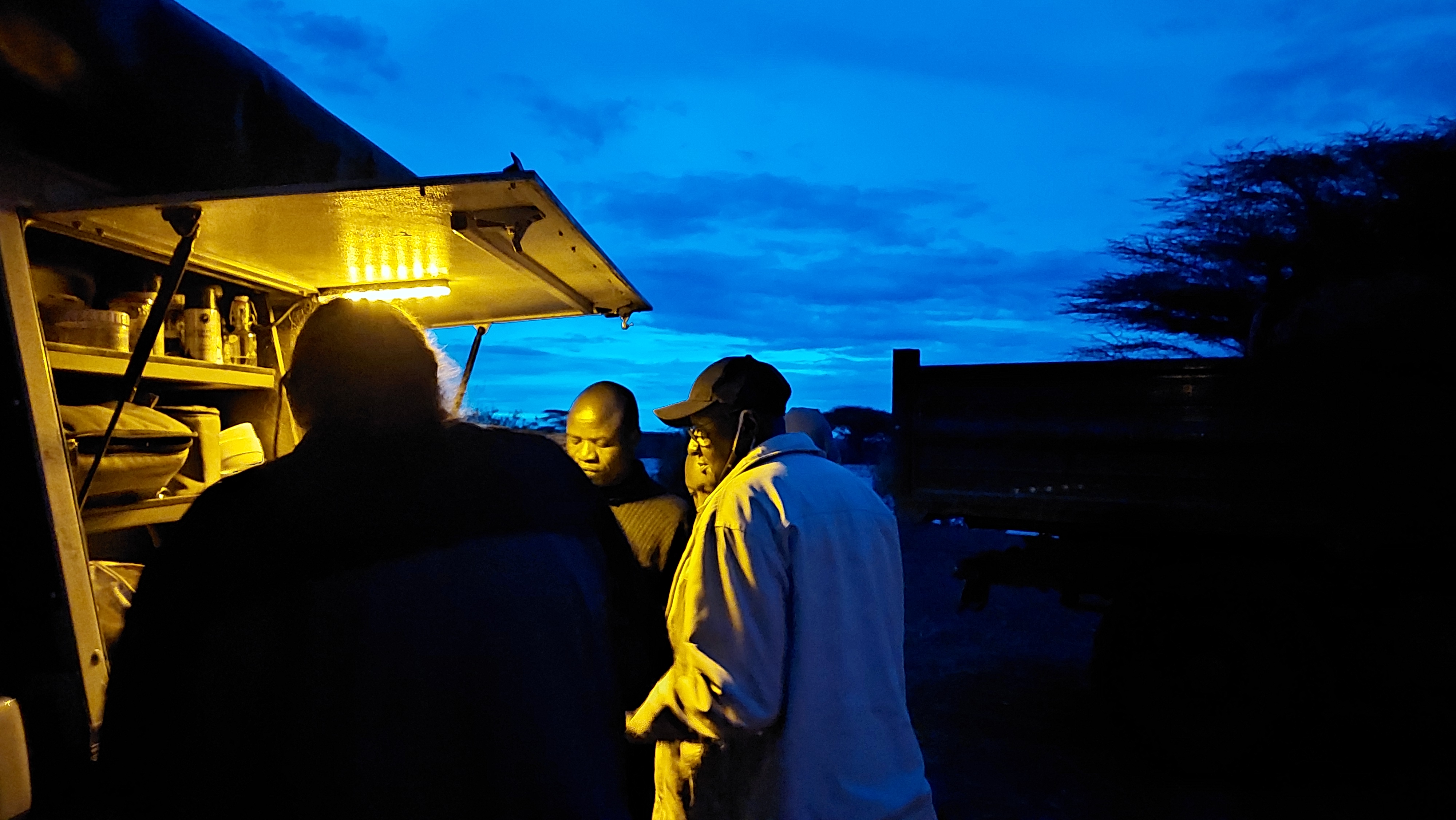
A watch system is set up and after a fitful night’s sleep we awake to way lower but still significant water levels. More waiting, more rounds of tea and coffee and until it’s time to move out. But not before prayers – I circle is formed and thanks are given including to us “our other African guests”. It’s very touching.
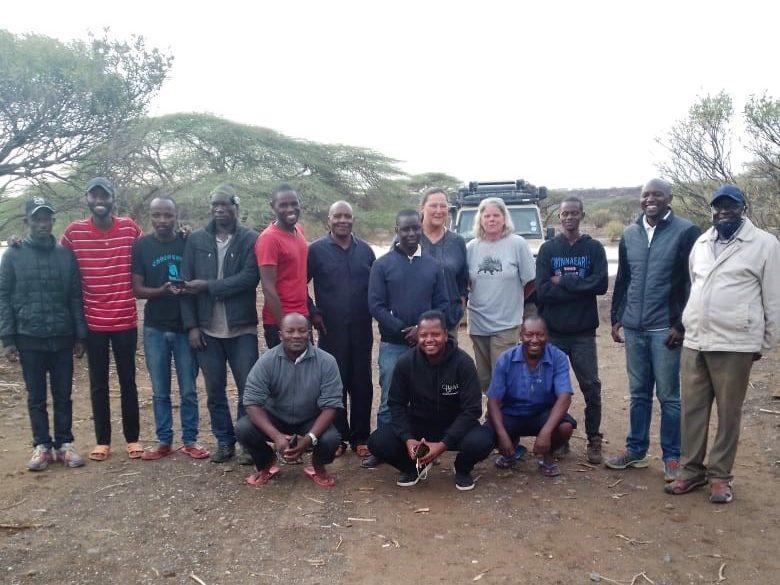
And then it’s time for a group photo – which I didn’t take but many did and WhatsApp-ed to us later. All shout out the equivalent of “say cheese” in Swahili. What do you say I ask Joshua – translates as ‘potatoes’ apparently
First to cross is the big truck which does fine until it doesn’t , getting bogged down in the soft muddy silt. It turns out to have a bigger problem…the 4WD is not engaging so the mechanics get going on that. More delays, but the water keeps dropping and I’m grateful for that. Next is the SUV. Which also gets stuck and well bogged in. Much digging. I get our MaxTrax down and wade out with those and a second shovel for the guys to use.

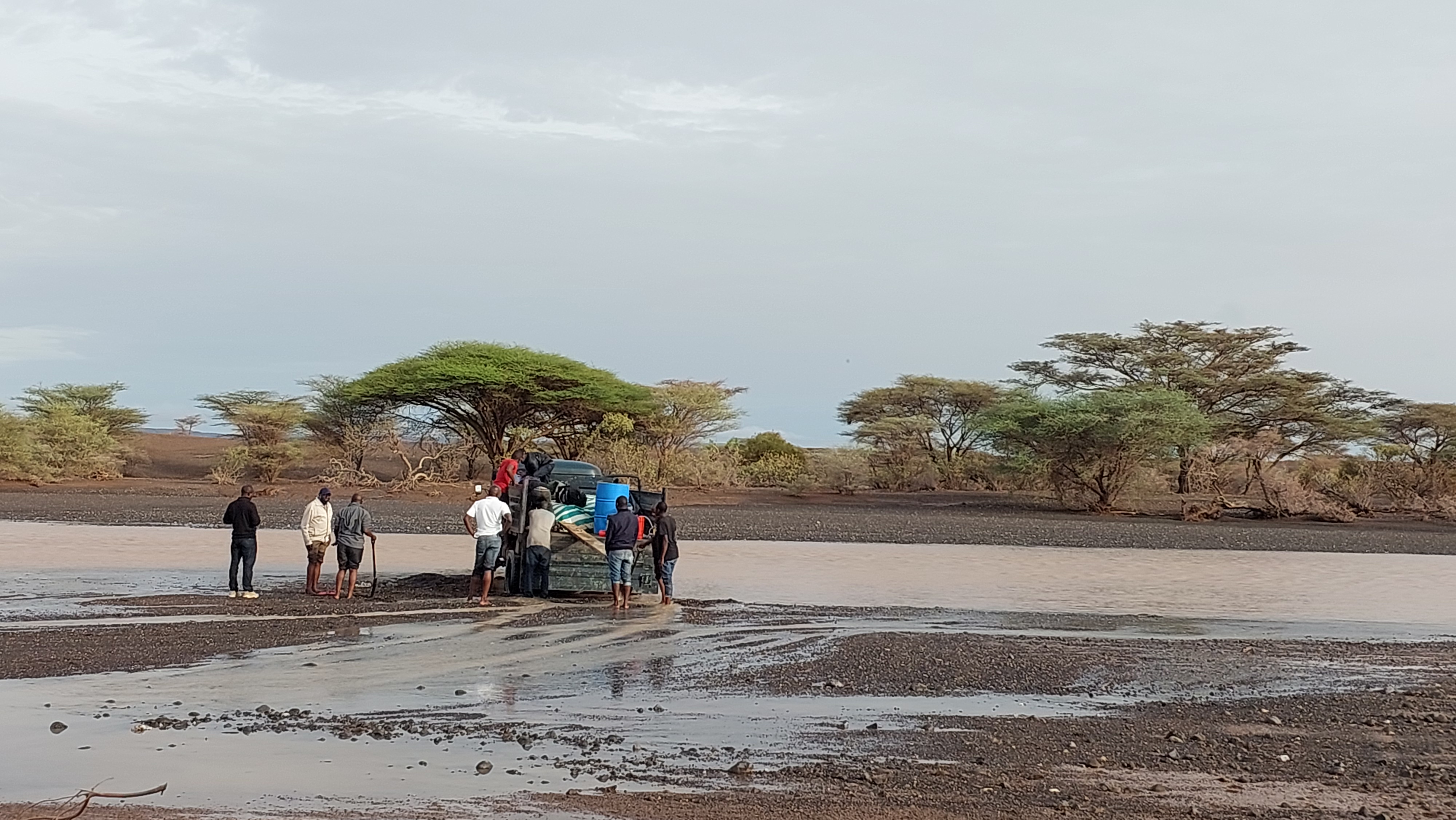
They try but really struggle and get no further. The bakkie crosses at a different point and makes it across. And then it’s our turn. Many offers to drive the Cruiser across for us but I demur. We follow the bakkie’s line, all eyes on us. Shackleton gurgles along in low range, please don’t get stuck, please don’t get stuck, please don’t get stuck I mutter under my breath. Hurrah! We’re across.
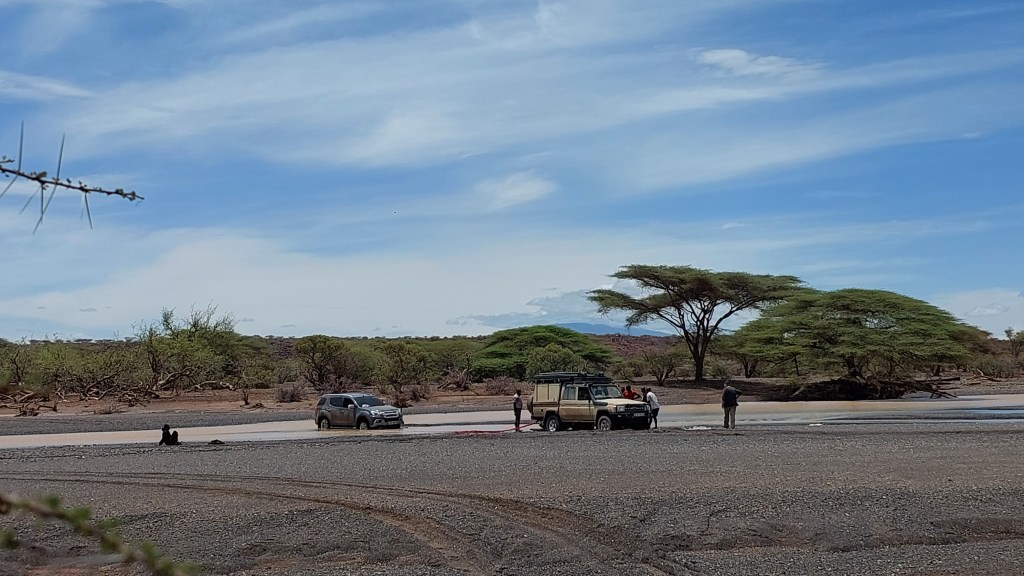
Once on the other side we are well placed to pull the SUV out but I don’t want to get too close and get us stuck too in the deep muddy silt that the flood has deposited. The longest rope we have is a kinetic strap so we’ll have to use that. We get all roped up and a small crowd gathers around the SUV wanting to help push. I explain that I want everyone a good distance away. I’ve seen what happens when a recovery point or rope fails and we are a very long way from any form of medical help. There is a bit of a stand-off and I refuse to do anything until they all move. Anyway the kinetic strap does its thing and we soon all on the road again.
Off we set (at pace, other than the truck which is now overheating so they have to stop to add water and let the engine cool) and after a while we are met by rangers from Sibiloi HQ who have driven out to meet their colleagues. We all stop at the top of a hill and war stories are exchanged. The road to Sibiloi is bad they say. They themselves had to use tracks and dig out in places. They don’t recommend trying in the SUV. HQ is delighted by this development – back to Loiyangalani it is! Sucker for punishment I ask if they think the Cruiser will make it…they look at me, look and the Cruiser…looking a bit doubtful. HQ interjects and starts singing our praises. They pulled us out the river! he exclaims all whilst offering rounds of tinned pineapple to us on a toothpick (the Sibiloi rangers came with supplies). The ranger points to Shackleton and says OK, it’s a strong car but there is one very bad bit. You will see it. Don’t try and do it – follow our tracks off to the side. I look at Deb, come on, let’s do it. At least we know Museums are following behind us. At that point we all go our separate ways, with the Sibiloi rangers off to North Horr where they have other business to attend to.
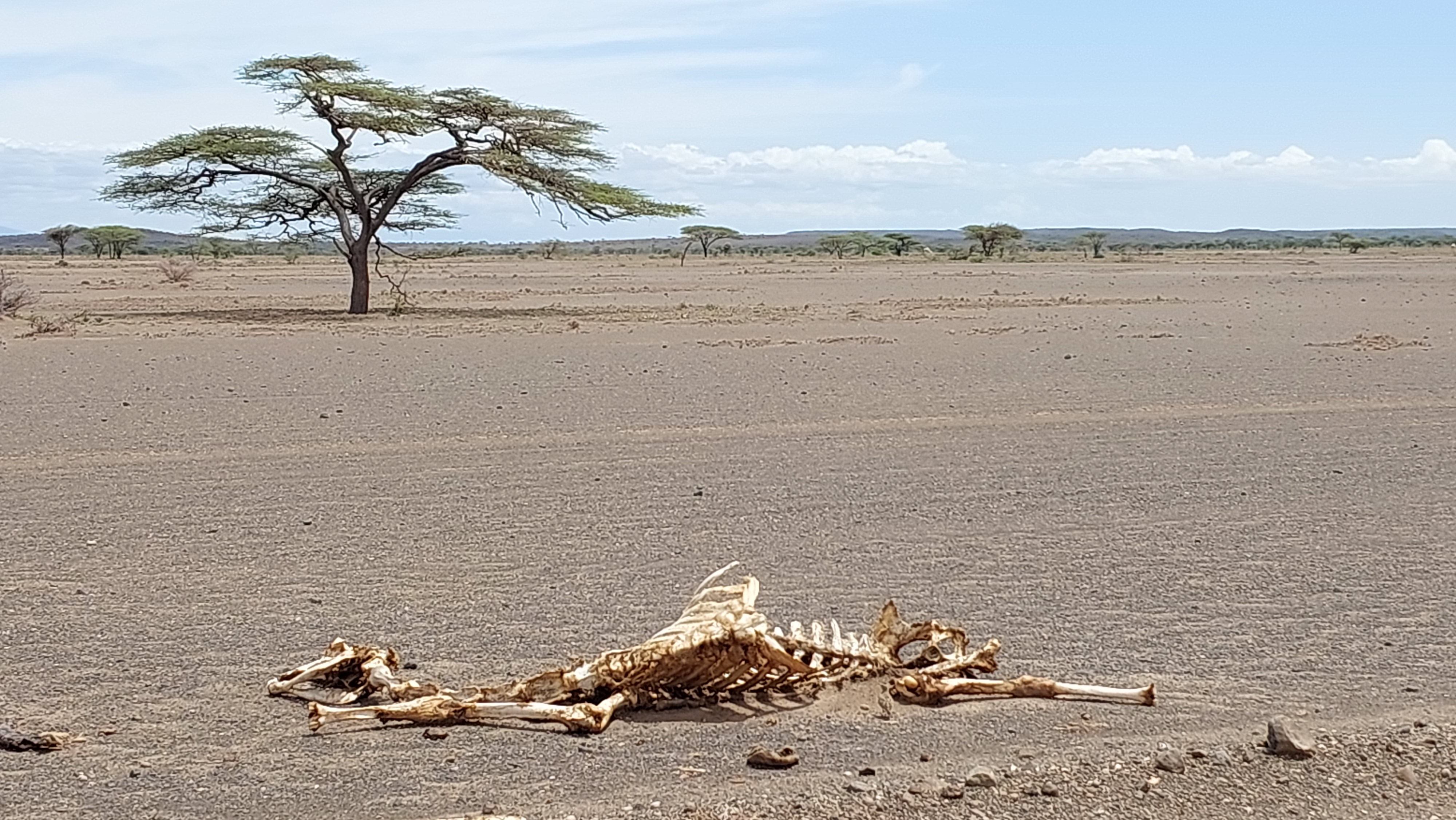
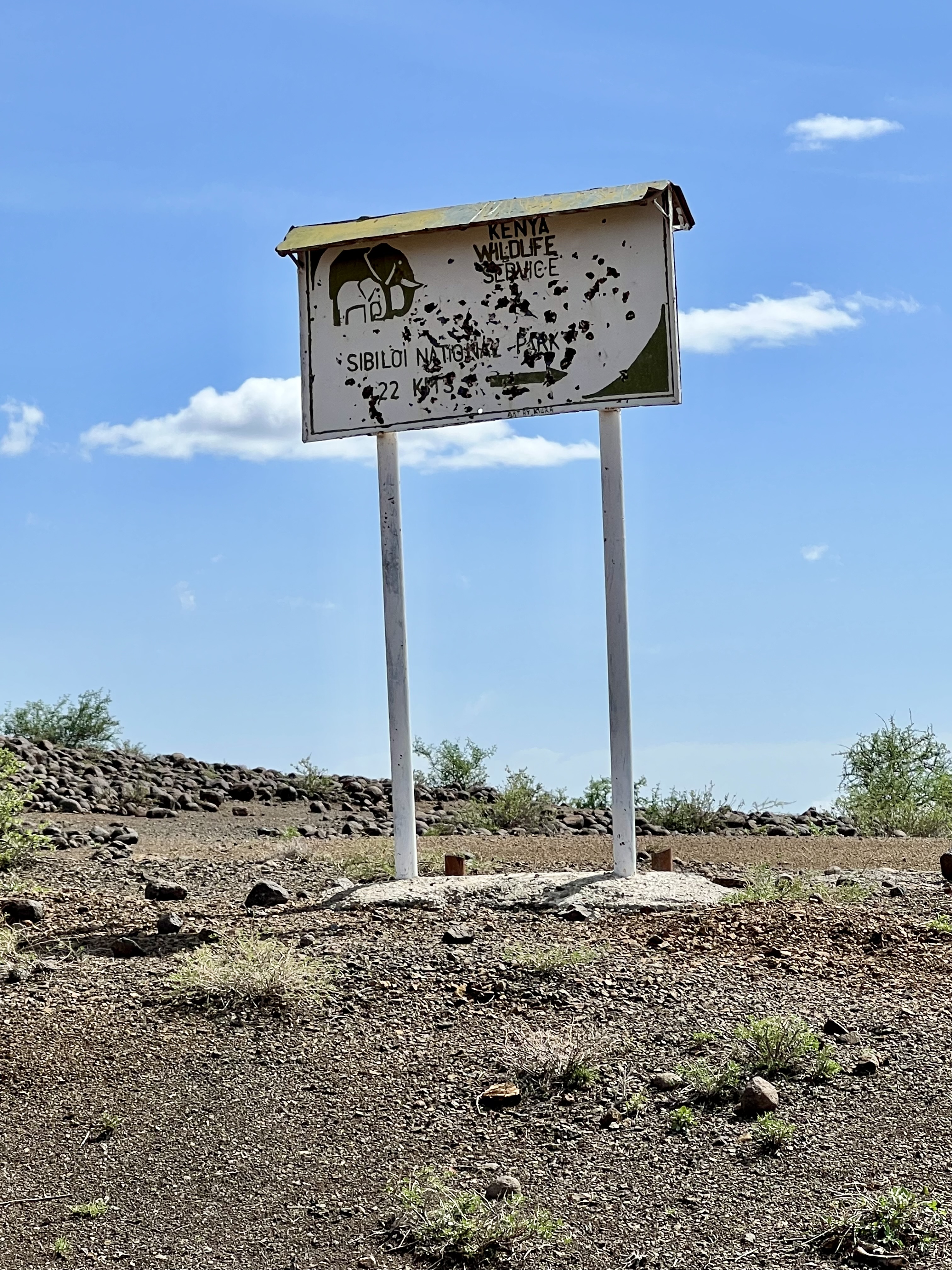
It feels very intrepid to be on our own again but liberating too as we follow that faint track into the wide empty landscape. Soon we hit a wider gravel road and it looks like we will be able to make up some time. We see the Sibiloi sign which is encouraging and it turns into a beautiful sunny afternoon. We don’t see and wildlife or even any livestock. Other than a lot of dead camels, some recently so and we wind up the windows against the stench.
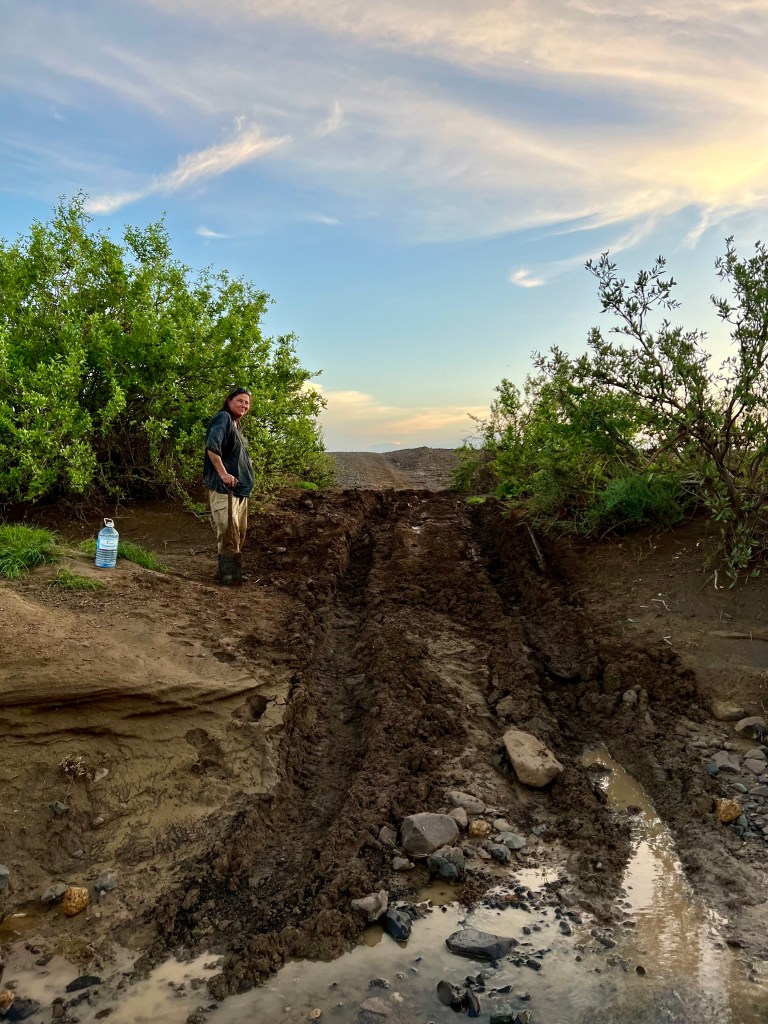
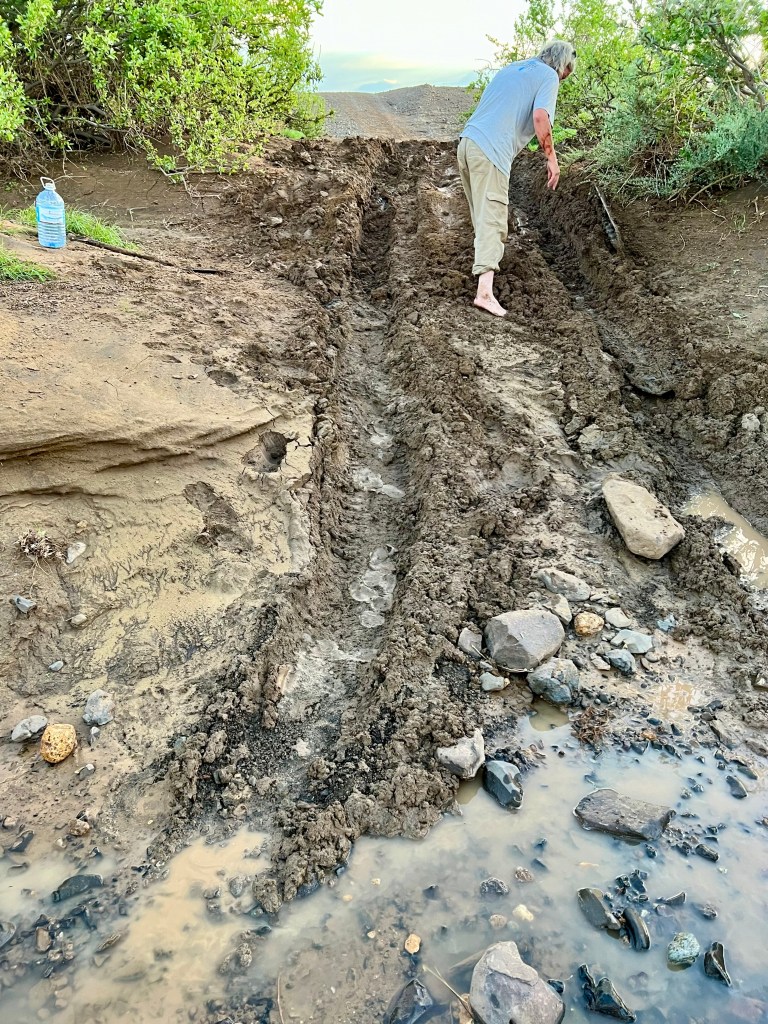
At one point we get to a section of road that, in short, looks like a bog of red shiny mud. Like it could swallow a car. This must be the bit we were warned about so we back track – and sure enough there are fresh tracks leading off to one side. So low range it is and off we set, following those tracks. We have no idea how long this detour is but I follow the deep muddy tracks religiously, pushing hard to keep up momentum until finally we emerge back onto the gravel road. We’ve had enough adventure for one day.
But actually its just starting. Looking at the time / date stamps on our photos I see that we left the rangers at 1pm. We only got to Karsa gate at 7pm. Looking at the map it can’t be a distance of more than about 60km. We got very stuck not once but twice. And each time we’d free ourselves, dig in again, free ourselves and dig in again. Have to say those MaxTrax are amazing pieces of kit. But you need to dig the vehicle free before you can use them. It was extremely hot and completely exhausting. But what to do? We got ourselves into that situation so we had to get ourselves out of it. And we were too tired to argue! The quality of the mud is hard to describe…it is incredibly heavy and sticky and almost sucks the vehicle down into it. So much so that at one point we even got stuck on a downhill.
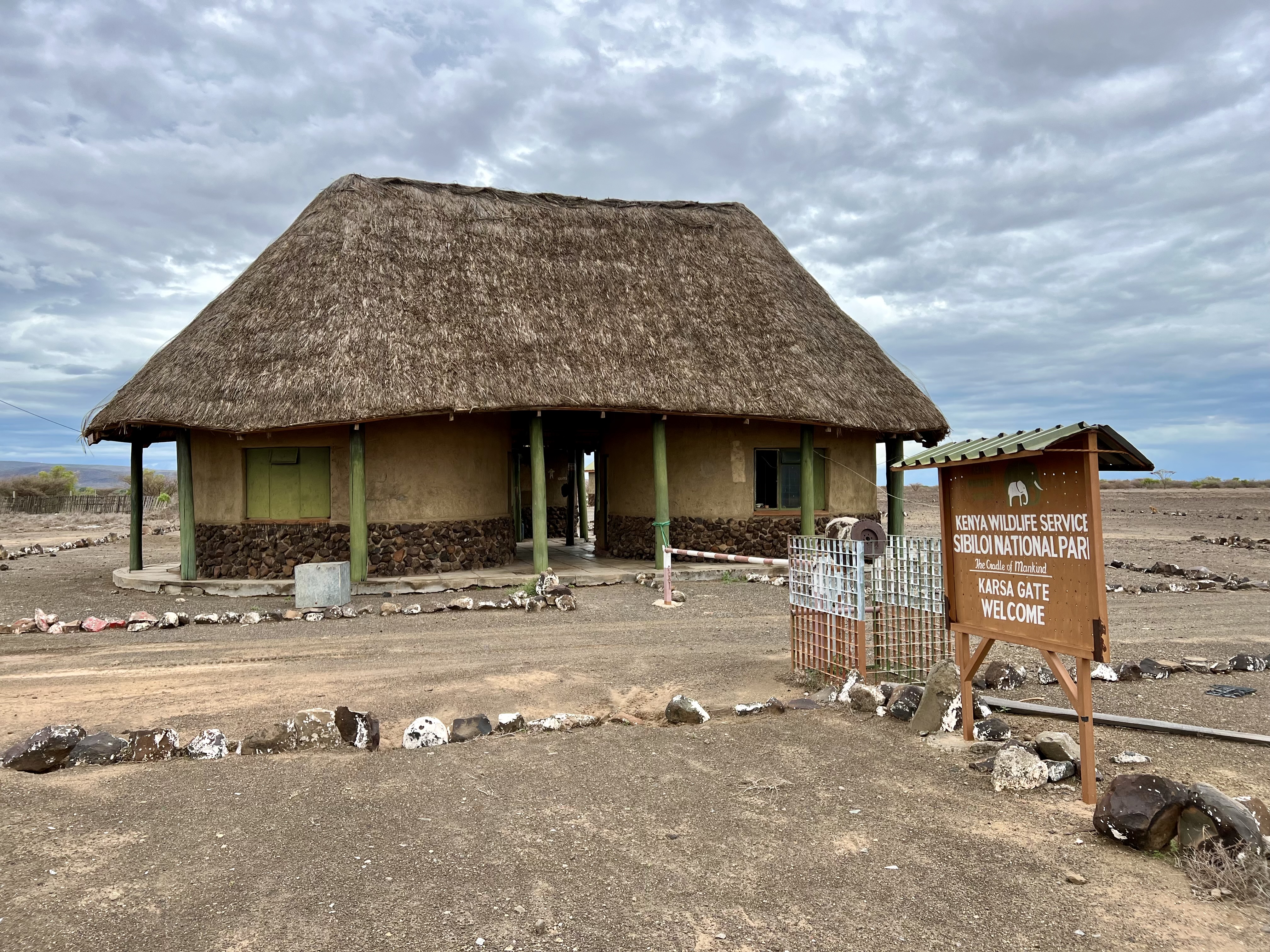
Finally we get to Karsa gate. We are late, very muddy and very tired. I resolve that if the ranger gives us uphill we will just camp outside the gate. We pull up at the reception building and a young ranger emerges:
His look says it all: WTF lady, it’s rainy season, what are you doing here?
My look: Hey bru’ I’m with you
You can’t camp here he says, this campsite is no longer in use. And we were not expecting you and the road to the campsite is not passable. He’s quite pissed off. I plead. Please can we come in and camp here. We’ve had a long day, and anyway there are more people on their way (I explain about the Museums dept and meeting their colleagues etc.). Otherwise you know what, we’ll just camp this side of the boom. For free.
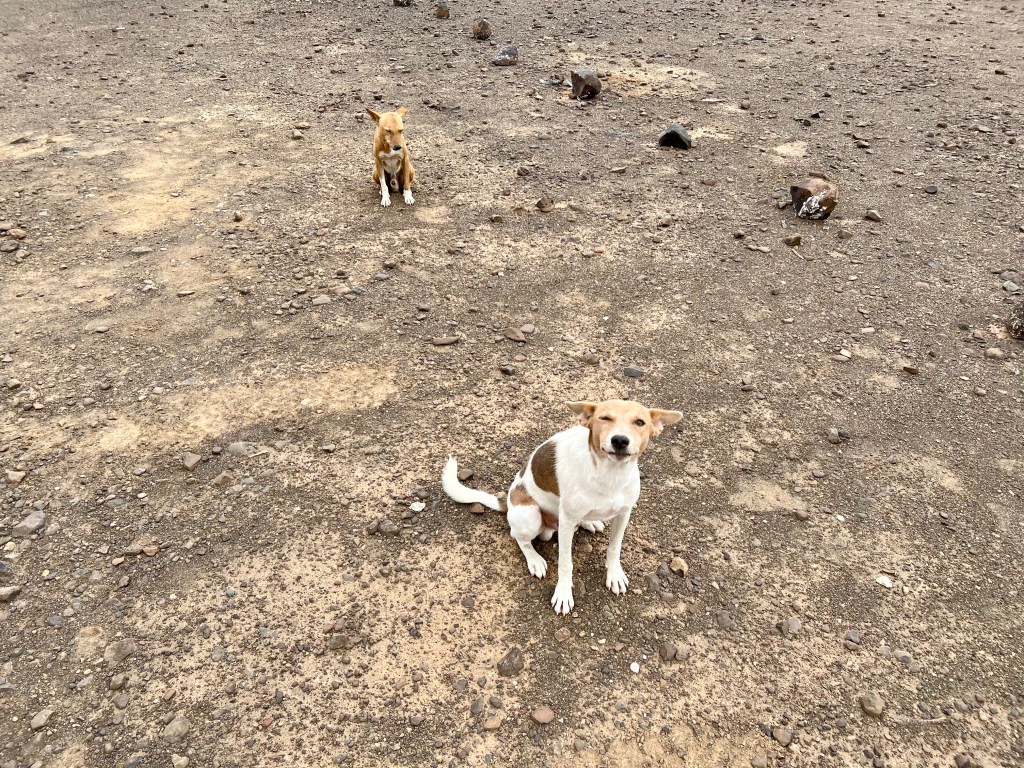
He softens and lets us though. Explaining where the toilets are and showing us the water tanks if we want to clean up. Am pleased about this. This is a really remote place and I want to be officially under their custody so to speak. He’s just finished eating and puts down some left over ugali for a pair of really rangy dogs. What are their names I ask? They don’t have any he says, they were just left here by some herders. They are good dogs though he says. They protect us from the hyenas. Really? Sounds like a tall story. Well then you really do need to give them names I say.
We set up in a corner, and fetch some water from the water tanks to have a wash. There are no showers but it’s amazing what you can do with a flannel and a basin. We have what our mothers’ would have called a “tart’s bath” and it feels fantastic. We also clean and patch up Debs elbow (she slipped and fell onto one of the MaxTrax and the nipples on the Trax are really sharp, splitting the skin on her forearm and elbow).
I make us a simple supper: penne, olive oil, garlic, tinned tomatoes, finish up a chunk of parmesan that we’ve carried all the way from Joburg, bust open the last bottle of Italian red from Watamu. Life is good.
We sleep like the dead and have a slow start in the morning. Am very stiff from all the digging, my hands especially – must be from the white knuckle death grip on the steering wheel. I put out the pot with the leftover pasta out some ways away for the dogs. They approach suspiciously, have a sniff and walk away. Am surprised – I thought they’d go or the fat, but clearly they are ugali specialists. I leave it out for a bit and the brown dog re-approaches and emerges with a piece of penne comically striking straight of out of his mouth like a whistle. He plays with it a bit but is clearly confused.
I go and chat to the rangers and ask (forever hopeful) if they have a map. And guess what? They do! Go figure – so I buy one. And it’s a very good map too. Using the map I ask which roads he thinks are drivable. Not many. But we could try Alia Bay. So late morning we set off on a drive. About 20 mins later we come to a river bed that has recently flooded. And yep. You guessed it. Stuck again. Aaargh. So it’s down with the MaxTrax, out with the shovel and reverse out. We both agree we are done. We’ve pushed our luck. Alia Bay and Sibiloi generally will have to wait for a revisit in the dry.
Back at camp we sit in our (expensive) car park watching the storms on the horizon, reading our books and enjoying doing nothing. Still no sign of Museums. We wonder what’s happened to them. Maybe the truck has broken down.
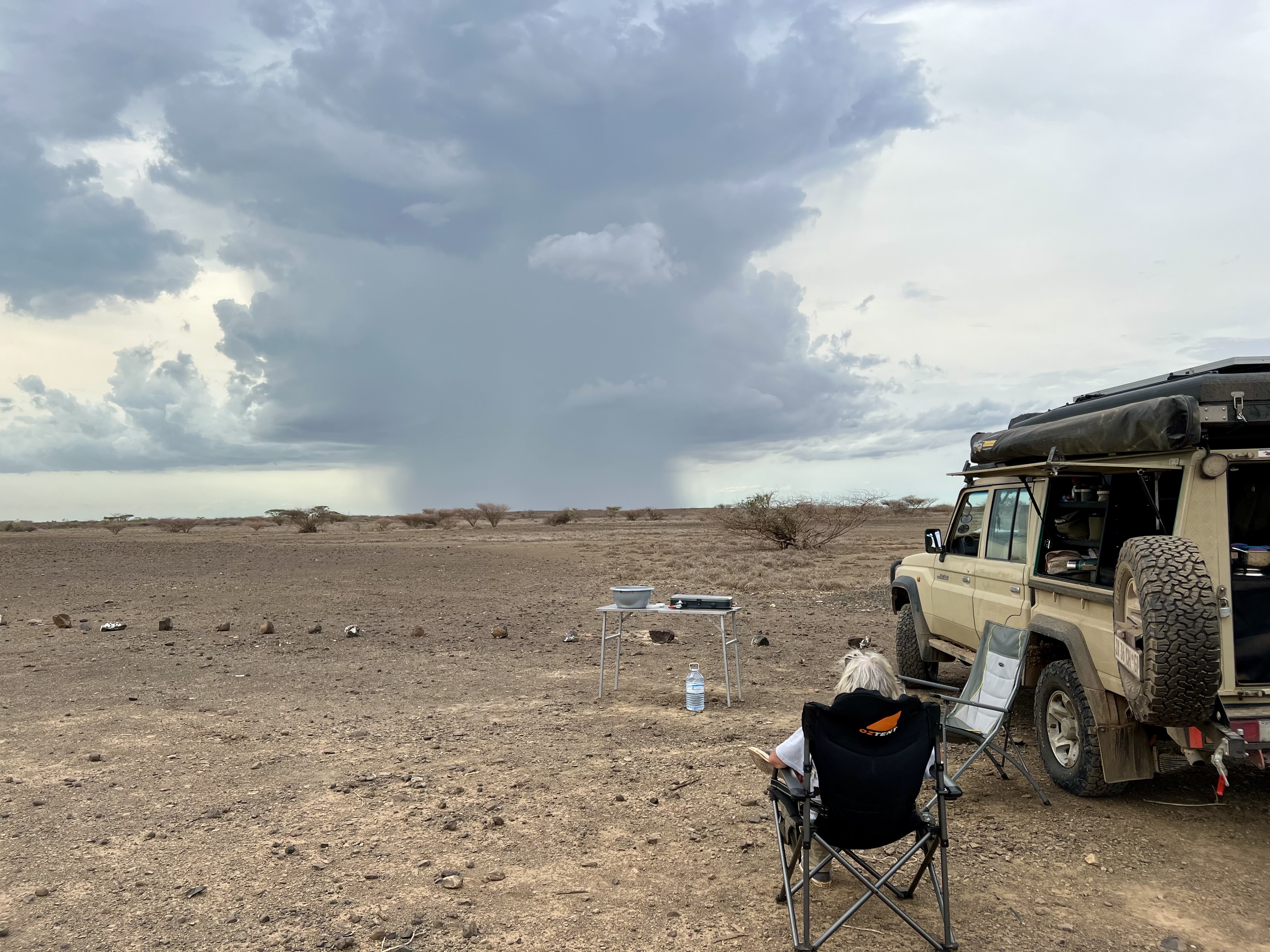
Towards sunset Museums finally arrive – they are delighted to see us. You made it! Damian comes across and asks for ‘his’ chair. We have a catch up. The truck got very stuck and they spent the better part of a day trying to free it. They are exhausted. Basically the plan is to make something to eat (I ask if they are OK on that front yes, we are fine – we will make ugali and garlic and greens) and then sleep. They will go and get the vehicle from Alia Bay first thing tomorrow and then we can drive back to Loiyangalani together before the weather gets any worse. That’s the plan.
Later that evening the hyenas start. Whooping and cackling, getting closer and closer. Next thing the dogs start up howling and barking and rushing into the darkness. The hyenas are closing in and you can hear them running. The dogs are determined, rushing them. I’m terrified one of these dogs is going to get shredded. But it never comes to that despite the running battle and soon the hyenas disappear and all is quiet. Remarkable.
I present to you the hyena wranglers of Sibiloi:
In the morning we are up early. Damian brings his chair back – see you just now and then we’ll leave. The truck and bakkie leave for Alia Bay. And we wait and we wait and we wait. They seem to be taking forever and its starting to rain. On no. The ground has in fact dried out considerably over the last two days and we want to take advantage of that. Maybe we should just leave. But somehow it feels like bad form. Eventually Deb calls it. Let’s go. I go to the rangers to leave a message for Damian. The rangers agree we should make a move before more rain. They radio Alia Bay and discover that Museums haven’t even arrived there yet. They must be stuck somewhere. That seals it. We are out of here.
Driving out we get to one of the places where we got stuck coming it. I can’t believe we have to do this again. I turn to Deb: I don’t want to do this. Its OK she says, I’ll try. I could have wept with gratitude. Those readers who know Deb might know that she is, how shall I put this….a more aggressive driver than I am. All the 4X4 training always says that you shouldn’t attack an obstacle, and only use as much speed as necessary. But I am now wondering if we just haven’t been aggressive enough. Anyway we swop seats. I immediately clip my safety belt in (which earns me a shirty look!) and we are off, attack is the right descriptor, engine revving, me yelling Go! Go! And we fly over. Awesome.
The rest of the drive back to Loiyangalani is thankfully uneventful, and everything has greened up. Crossing the river where we spent the night is fine as whilst there is still a lot of water its dropped enough to see where / how to avoid the silty areas.
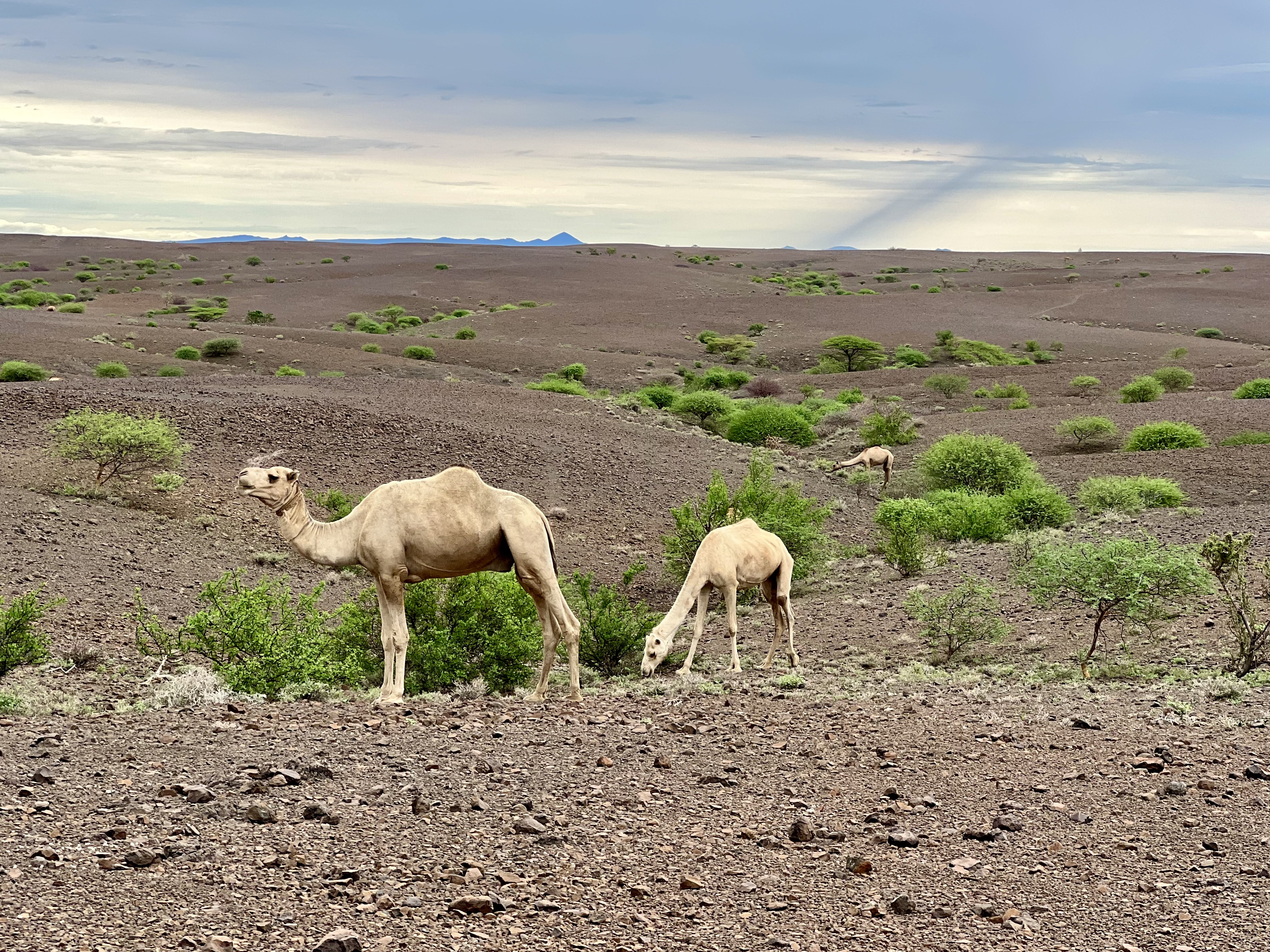
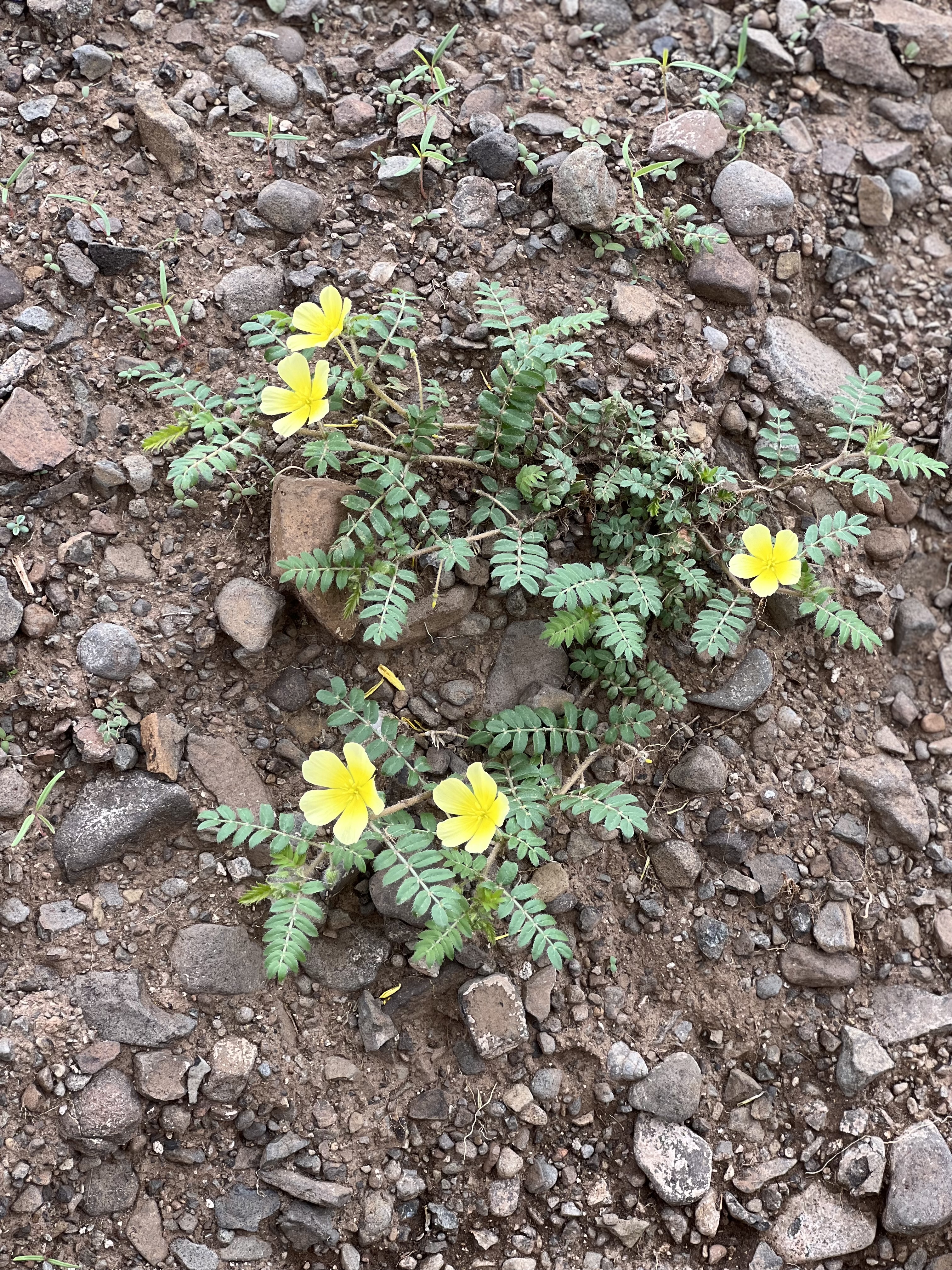
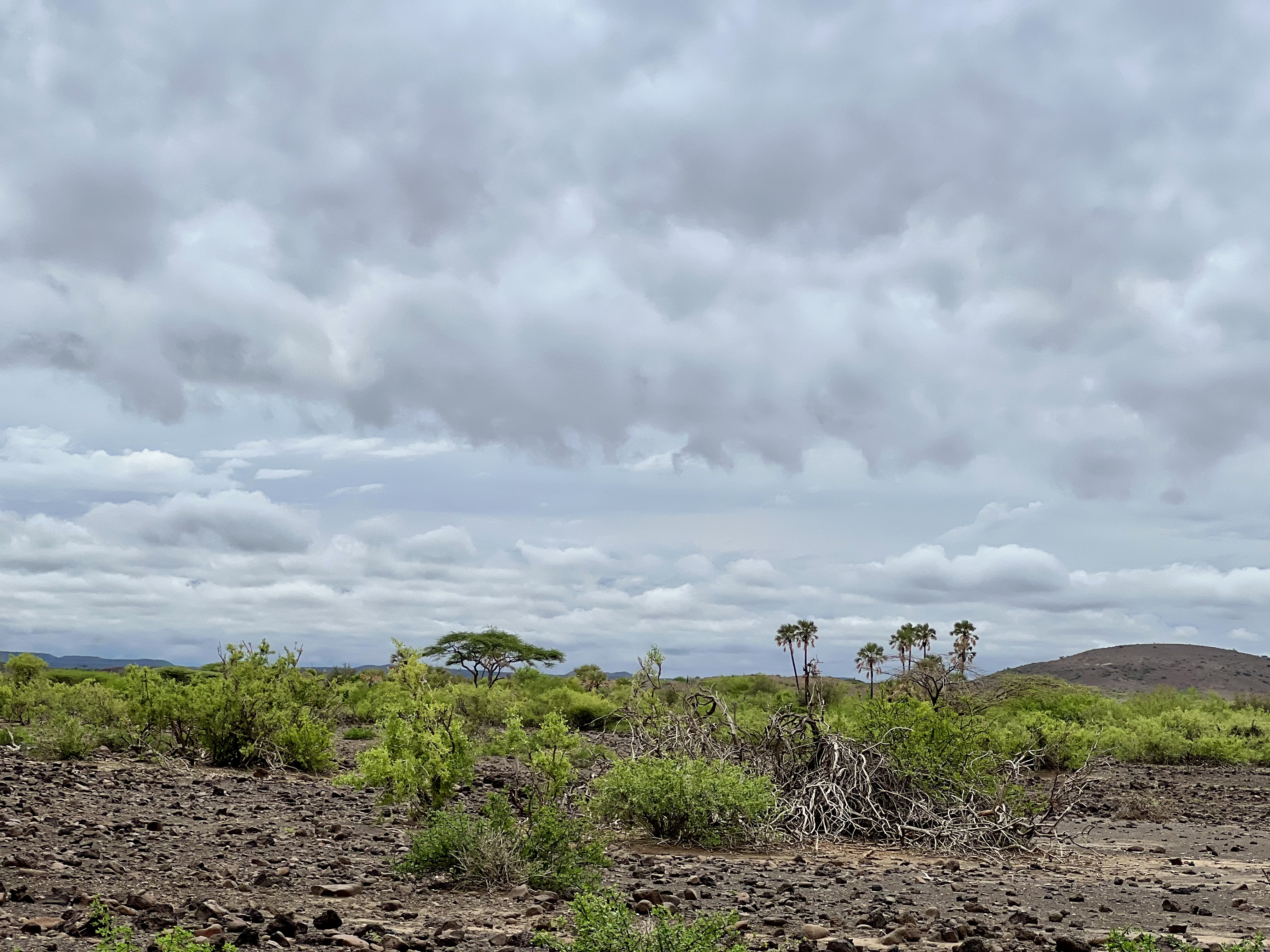
Back at Palm Shade it’s very quiet and we set up in the garden. We have a beer or two and chat to the staff and manager. Things are tough here, especially post Covid but they are trying hard to make it work. We sense some resentment towards the authorities, feeling that they are treated as a backwater without the infrastructure support they need and want. Look at the Wind Farm, and we don’t even have reliable electricity.
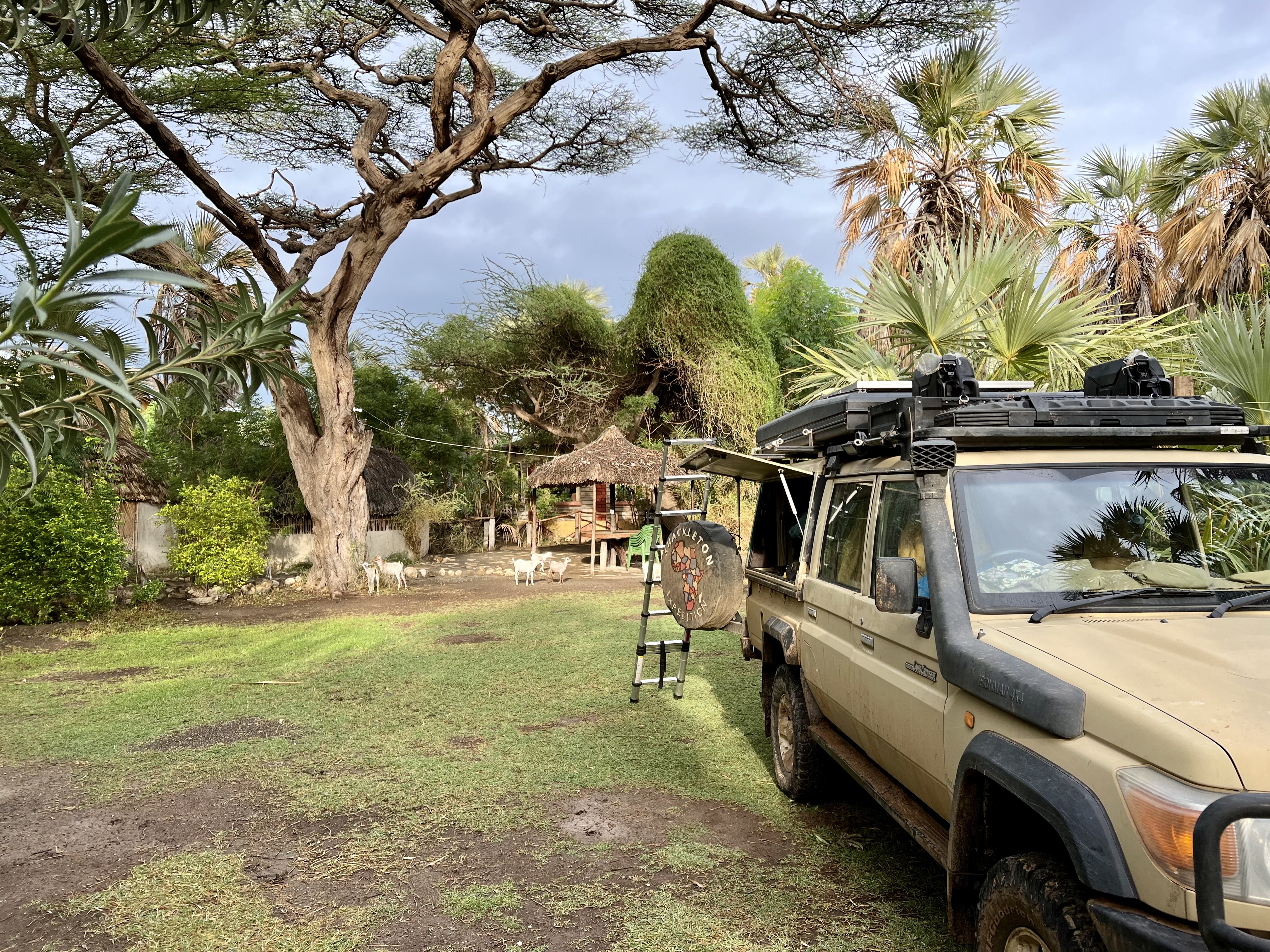

In the morning the manager is ever helpful and comes to ask re our route out. The Malgis river is in full flood he says, so you need to avoid that. There is a way but he will need to explain it. Also he’s not sure if that route isn’t also impassable, but someone left on that route early this morning. Let’s give them another hour or so and then we can call and see how they got on. We get this traveller on the phone and he confirms that the alternative route (via Ilaut & Log-Logo is feasible)
The manager explains the way and I scribble directions down on the back of my birthday card from my sister.
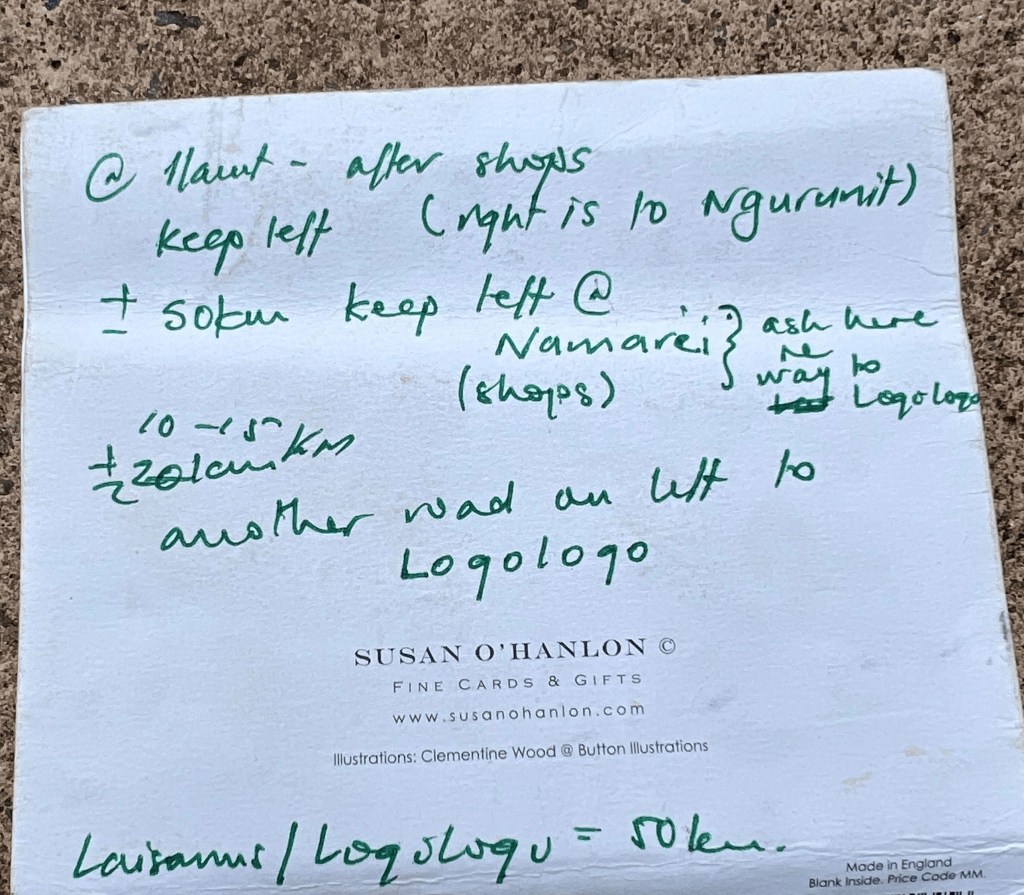
So off we set, retracing our steps. Back through South Horr and the wells at llaut. Here we bear left and head north east, rather than going back the same way thought Ngurunit. The road isn’t too bad bar some exceptionally slippery bits where the mud coats the tyres and your traction is zero. We even spot a couple of gerenuk. They turn out to be excellent directions and we find ourselves back on the smooth tar, emerging about 50km north of Laisamis. Seeing that tar road spread out in front of is just beautiful.
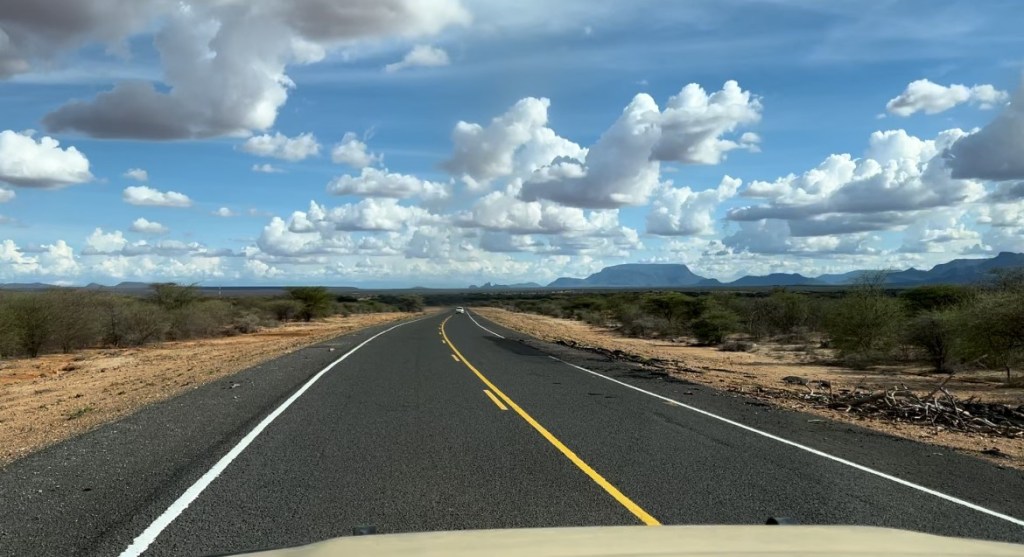
We bomb along the A2, over the Malgis (which is indeed in full flood) and all the way back, past Archers’ Post, Isiolo and finally Nanyuki. We phone ahead to Penguin House – yes they have room. It’s getting dark but we know the way, wiggling through the back streets of suburban Nanyuki, past the Adults Live Here wifi, finally at Penguin House and straight into the arms of Kowalski. It feels like a homecoming.
Next stop Nairobi
NOTES FOR TRAVELLERS:
- Don’t go to Sibiloi in the wet
 Bonnievale to Burton Fleming
6 responses to “Maritime & Museums: Adventures on the Road to Sibiloi”
Quite an adventure!
LikeLike
A bit more than we bargained for …
LikeLiked by 1 person
OMW what an adventure. So glad you never crossed that river. So proud of you both.
LikeLike
Wow you two are amazing. What an adventure and I love
the comment the husbands have gone fishing, so clever. Xox Joanah.
LikeLike
Thanks Joanah!
LikeLike
Beautifully written. What an adventure!
LikeLike